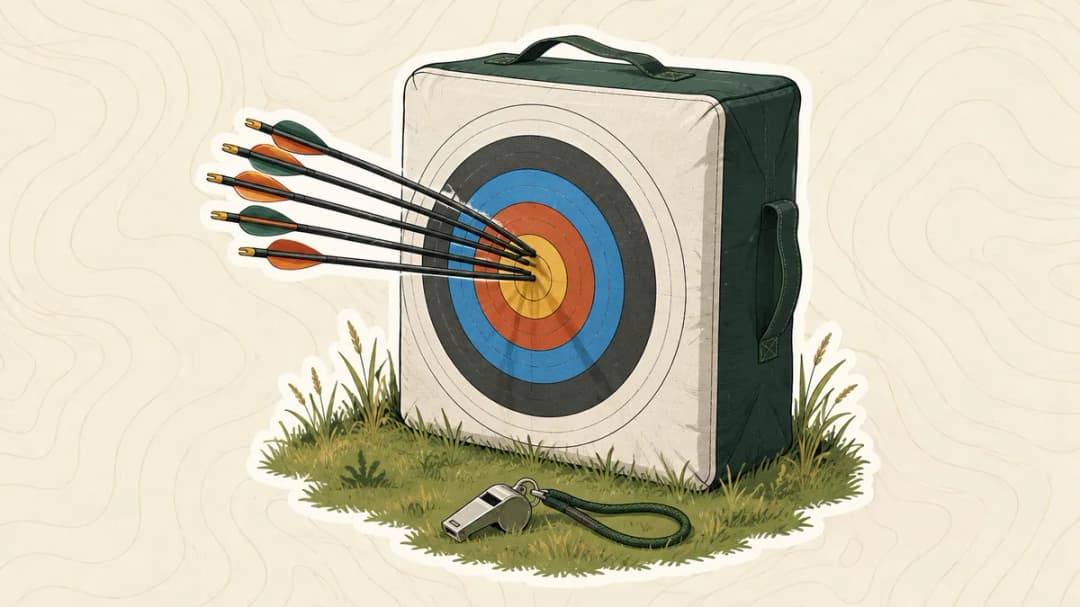


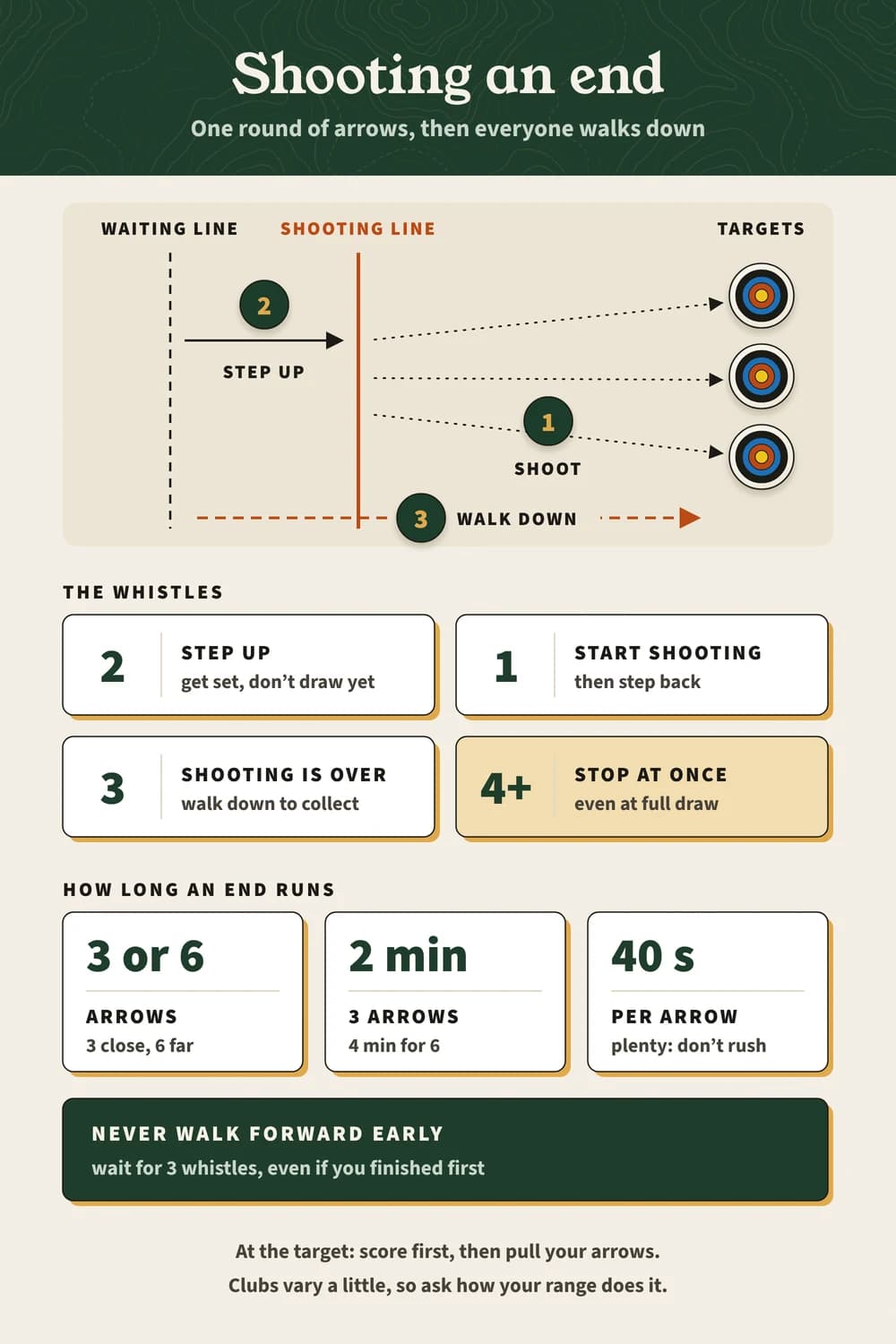
- An end is one round of arrows, 3 or 6, that everyone shoots before walking down to score and pull.
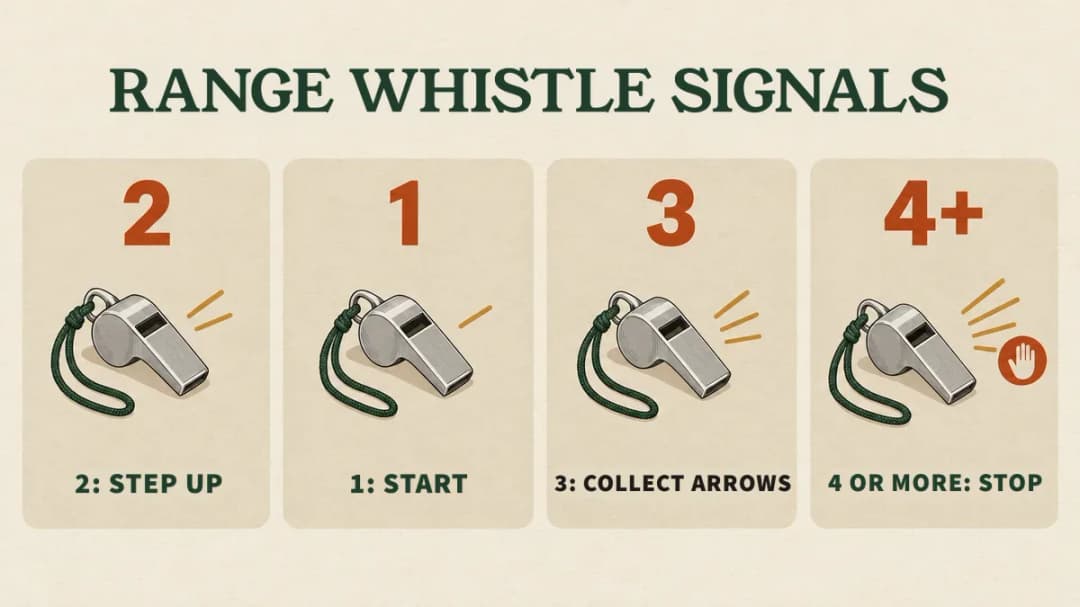
- Ranges run ends with whistles: 2 to step up, 1 to shoot, 3 to collect, and 4 or more to stop at once.
- Never walk forward before the collect signal, even if you finished first. Not once.
- Expect about 2 minutes for 3 arrows and 4 for 6: plenty of time, so don’t rush.
- Shoot ends at home too: score every one and your practice turns into numbers you can improve.
“Last end!” Someone calls it, the whistle goes, and the whole line moves except you. 😬
Relax: an end is just one round of arrows, and the whistles only ever mean step up, shoot, stop or go collect. Learn the four signals below and you’ll fit in on your first club night (the beginner guide covers the rest of range day).
How an end works: 3 or 6 arrows, then everyone walks down
An end is a set of arrows everyone shoots before the whole line walks down to score and pull them. Indoor rounds and short outdoor distances use 3 arrows per end; long outdoor distances use 6.
Ends keep everyone on the same rhythm so nobody is shooting while someone else is at the target. That shared rhythm is what makes a busy range safe.
Two-time Olympic silver medalist Jake Kaminski explains why close-range ends are short. And it has nothing to do with stamina:
The reason that we do three arrow ends up close is because we’re preventing arrow damage, we’re preventing arrows from smacking against each other and breaking them.
Thats worth copying in your own practice. If your arrows are hitting each other at short range, shoot fewer per end or aim at different spots: a broken nock or a split shaft costs more than one extra walk to the target.
// Free printable
Get the range log I actually use.
Seventeen printable pages: session log, score tracker, a 30-day drill challenge, a bow maintenance card, a first-season checklist and more. Join the monthly email and it lands right away.
Range whistle signals: what each one means
Most ranges and tournaments use the same whistle system, with beeps or lights doing the same job at some. Learn these four and you can follow any end.
| Whistles | Meaning | What you do |
|---|---|---|
| 2 | Step up to the shooting line | Walk up and get set; don’t draw yet |
| 1 | Start shooting | Shoot your end, then step back behind the line |
| 3 | Shooting is over | Walk down together to score and collect |
| 4 or more, fast | Emergency: stop shooting at once | Let down, arrow back in the quiver, step back |
Kaminski is clear about that last signal:
If you have four whistles or more, that means there is some imminent danger, some emergency, whatever you are doing, stop shooting. Even if you’re at full draw, about to shoot, you set your arrow down, put your arrow back in the quiver, step off the line, and wait for more instructions.
The part beginners struggle with is “even if you’re at full draw”. Letting down a drawn bow feels wrong the first time, so practice it: draw, ease the string forward under control and put the arrow away. And never release with no arrow on the string to “get rid of” the draw: that’s a dry fire.
How to shoot an end, step by step
Every end follows the same loop. Once you’ve done it twice, it runs itself.
- Wait behind the waiting line with your arrows in the quiver until you hear two whistles.
- Step up and get set, straddling or standing on the line, with the bow pointed down range.
- Nock and shoot only after one whistle, then step back behind the line when you’re done.
- Walk down together after three whistles, never before, and never run.
- Score, then pull your arrows, and walk back for the next end.
Someone at the range showed me how it all worked when I started:
Luckily there was someone at the range that actually showed me how to do things.
That’s normal, and asking is the fastest way to learn a range’s routine. People would much rather explain the whistles than watch you walk forward at the wrong time.
How much time you get for an end
In tournaments, ends are timed, and the numbers sound tighter than they are. The standard is about 2 minutes for 3 arrows and 4 minutes for 6, with 10 seconds to get to the line after the two whistles.
In general, you can say you have 40 seconds per arrow. It is a ton of time, trust me. It may be daunting to hear you only have 2 minutes for three arrows, but it is plenty of time.
I agree, and the catch is that rushing is the real risk, not the clock. At a club night nobody is timing you, so take a full breath at anchor on every arrow and let the end take as long as it takes.
Scoring and pulling arrows at the end of an end
At the target, the order matters: score first, pull second, so nobody loses a score by pulling an arrow too early.
- Walk to the side of the target, not straight at it, so you don’t step on arrows in the grass.
- Call your scores highest first; an arrow touching a line scores the higher ring.
- Check behind you before you pull: nobody should stand behind the arrows.
- Pull straight out with one hand flat on the target and the other gripping the shaft right at the face.
- Don’t touch other archers’ arrows unless they ask, and look for misses before you walk back.
Shoot ends at home to make practice count
Ends aren’t just a club rule. Shooting in fixed ends of 3 or 6, and writing down each end’s score, is the easiest way to see real progress, because one great arrow stops fooling you.
| Practice goal | End size | Distance | Track |
|---|---|---|---|
| Form work | 3 arrows | 5–10 yards | How each shot felt |
| Grouping | 3 arrows | 10–15 yards | Group size |
| Scoring | 6 arrows | 18–20 yards | End total |
| Stamina | 6 arrows, 10 ends | Your usual distance | Score of the last 3 ends |
Save this one-page version of an end and the whistles will make sense on your first club night.
// FAQ
Frequently asked questions
Quick answers to the questions readers ask most.
How many arrows are in an end?
Usually 3 indoors and at shorter outdoor distances, and 6 at longer ones. The round sets the number, and the range or tournament will tell you.
What do 3 whistles mean in archery?
Shooting is over for that end, and archers can walk down to score and collect arrows.
What do 4 or more whistles mean?
An emergency: stop shooting at once, even at full draw, let down, put the arrow back in the quiver and step back from the line.
Do I have to use whistles at a backyard range?
Not whistles, but the idea still applies: everyone shoots, everyone stops, then everyone walks down together.
What does “Fast!” mean at an archery range?
Stop shooting immediately. Let down your draw and put the arrow back in your quiver.
Final thoughts
An end is simple: shoot together, stop together, collect together. Learn the four whistle signals and your first club night will feel easy.
Log each end’s score in the free range log, and you’ll see your progress end by end.
