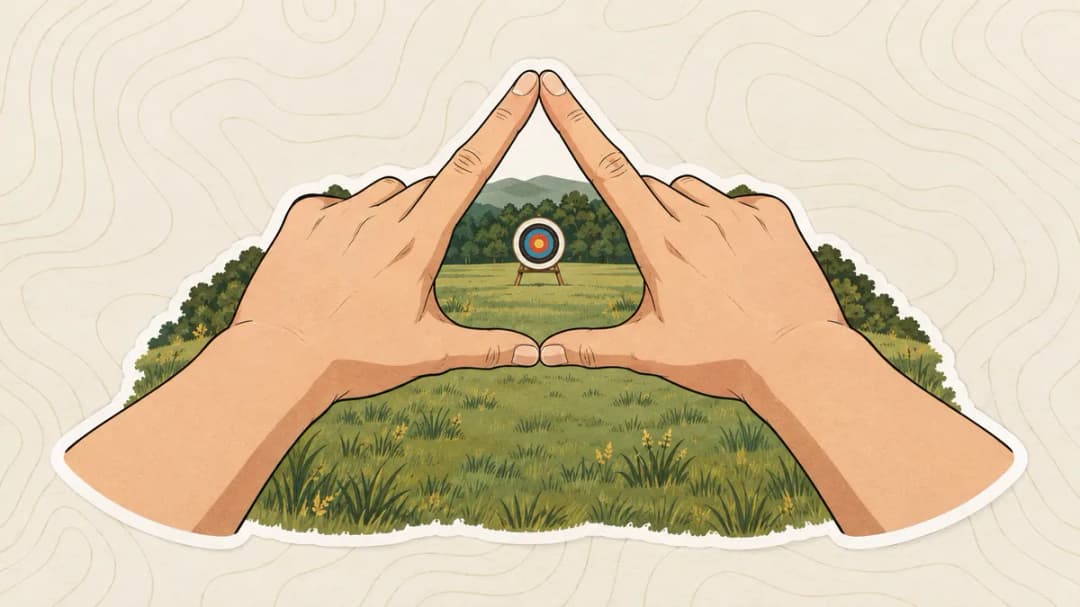


- Find your dominant eye in 30 seconds with the triangle test: frame a distant object, then close one eye at a time.
- Buy a bow for the same side as your dominant eye: right eye, right-handed bow.
- Cross-dominant and just starting? Switch hands. You have the least to unlearn now.
- If switching won’t stick, cover the dominant eye with a small patch or tape on your glasses rather than squinting.
- Test before you buy: right- and left-handed bows aren’t interchangeable.
Same form, same careful aim, and the arrows still drift to one side. It might not be your hands at all. 👀
Your dominant eye is the one your brain trusts when you line something up, and if it isn’t the eye behind the arrow, your aim is off before you release. The test takes 30 seconds and the fix is a choice of side (the recurve beginner guide covers the rest of aiming).
How eye dominance moves your arrows
When you aim with both eyes open, the dominant eye decides where you’re pointing. If it sits on the other side from the string, you line up the shot with the wrong eye.
That usually shows up as arrows grouping off to one side, no matter how good your release is. A tight group in the wrong place is the classic sign: your form is repeating, your eye isn’t lined up.
Aiming surprised me when I started, coming from firearms:
I guess what I thought would be easier was just accuracy.

// Free printable
Get the range log I actually use.
Seventeen printable pages: session log, score tracker, a 30-day drill challenge, a bow maintenance card, a first-season checklist and more. Join the monthly email and it lands right away.
The triangle test: find your dominant eye in 30 seconds
This is the classic test, sometimes called the Miles test. Do it with both eyes open and a target or light switch across the room.
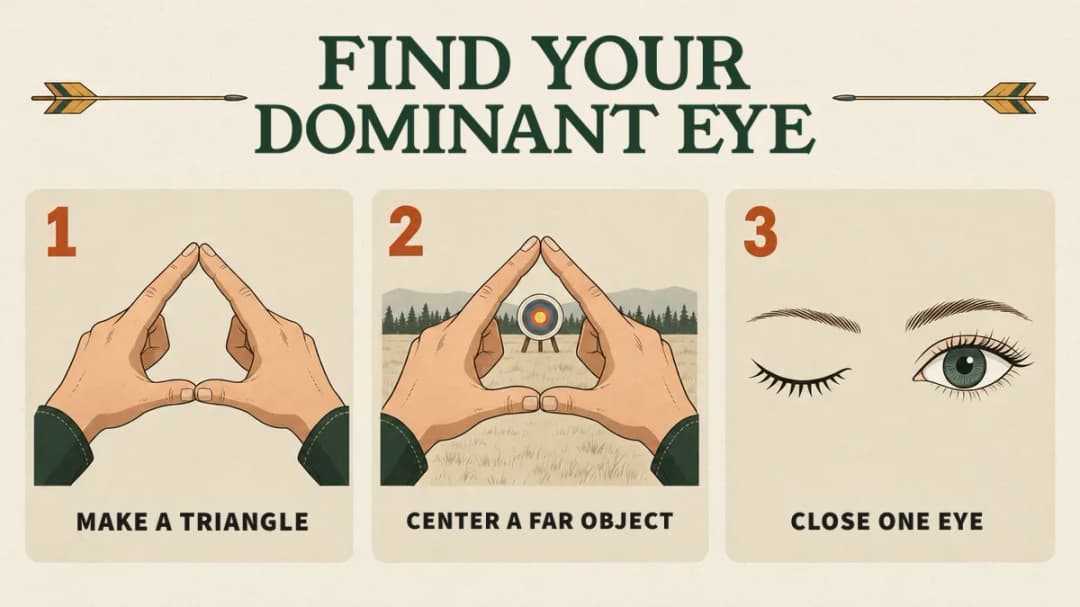
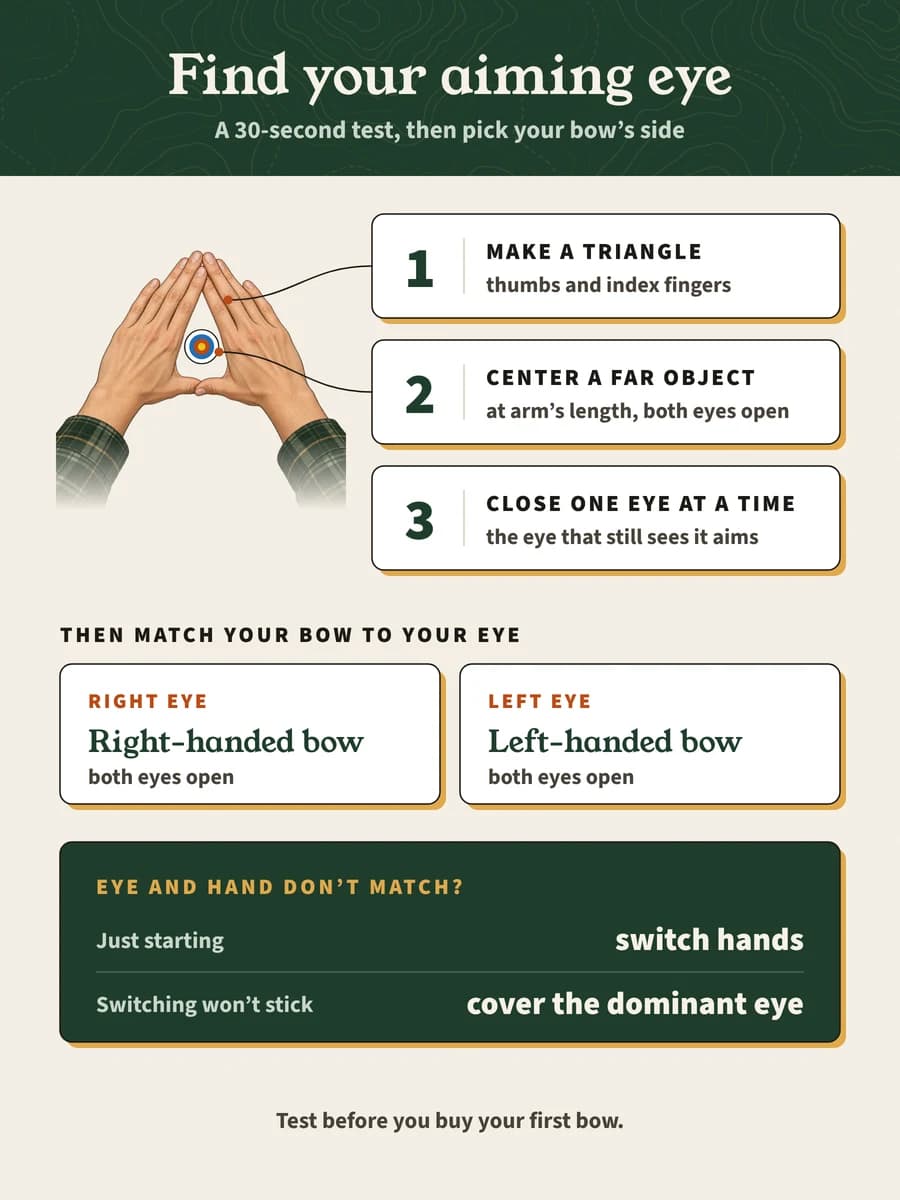
- Make a small triangle with your thumbs and index fingers and hold it out at arm’s length.
- Center a far object in the triangle with both eyes open.
- Close one eye, then the other. The eye that still sees the object in the triangle is your dominant eye.
For a second check, keep both eyes open and slowly bring the triangle back to your face. It comes back to your dominant eye. Do the test three times on different days if the result surprises you.
Which hand to shoot with: match the bow to your eye
Right-handed bows are drawn with the right hand and aimed with the right eye; left-handed bows the opposite. The easy match is a bow for the same side as your dominant eye.
| Your dominant eye | Your strong hand | What to do |
|---|---|---|
| Right | Right | Right-handed bow, both eyes open |
| Left | Left | Left-handed bow, both eyes open |
| Left | Right | Cross-dominant: switch to a left-handed bow, or cover the left eye |
| Right | Left | Cross-dominant: switch to a right-handed bow, or cover the right eye |
Cross-dominant? Switch hands if you’re just starting
Being cross-dominant is common and easy to work around. If you’re just starting, switch hands; cover the eye only if switching won’t stick.
NUSensei, an archery coach who has started a lot of new archers, explains why the hand is the easier thing to change:
For many people it’s easier to shoot with the opposite hand than it is to shoot with the opposite eye. It does take time to adjust, but eye dominance is normally more ingrained, especially for an adult.
That’s the case for switching early. Your hands can learn a new job; your eye won’t change sides, so the sooner you pick the bow for you’re eye, the less you have to unlearn.
- Buy or borrow a bow for your eye’s side: a left-handed bow for a left eye, held in the right hand.
- Start light: your new draw arm is your weaker one, so pick a lower draw weight than you would otherwise.
- Shoot close: a few sessions at short range let the new side feel normal before you chase groups.
- Keep both eyes open: that’s the point of switching, and it’s more relaxed than holding one shut.
What about keeping your hand and tilting your head over so the other eye sits behind the string? He tries the workarounds on camera and his verdict is blunt:
So unfortunately if you are cross dominant I don’t think there is a viable method to adapt standard archery techniques in order to make use of your opposite eye.
I agree, and his reason is the one to remember: tilting your head moves your anchor, and your anchor is your rear sight. Switch hands or cover the eye; don’t bend your form around it.
If you won’t switch: cover the dominant eye
Some archers have shot one side for years. Or simply can’t get comfortable on the other. Then block the dominant eye instead of fighting it.
- Close the dominant eye: simple, though holding one eye shut takes effort and can tire your face.
- Cover it: a small blinder, patch or a bit of tape on your glasses blocks the dominant eye while it stays open and relaxed.
- Keep the cover small: just enough to hide the target from that eye at full draw, so you still see the range around you.
Here’s the whole test on one page, worth doing before you buy a bow.
// FAQ
Frequently asked questions
Quick answers to the questions readers ask most.
How do I know which eye is dominant?
Frame a distant object in a triangle made with your hands, then close one eye at a time. The eye that keeps the object in the triangle is dominant.
Should I shoot with both eyes open?
If your dominant eye matches your bow’s side, yes: it’s more relaxed and lets more light in. Cross-dominant archers usually close or cover one eye.
What if my results change between tests?
Some people have no strong dominant eye. Pick the side that feels natural and close or cover the other eye when you aim.
Is it too late to switch hands?
It’s easiest in your first months, but it’s never impossible. If you’ve shot one side for years, covering the eye is usually the faster fix.
Does eye dominance matter with a crossbow or a scope?
Yes. You still aim with one eye behind the scope or sight, so shoulder the crossbow on the side of your dominant eye if you can.
Final thoughts
Eye dominance takes 30 seconds to check and can save months of chasing arrows that land off to one side. Test it, match your bow to it, and switch hands early if you have to.
Note which eye you aim with in the free range log, and watch how your groups tighten once it matches.
