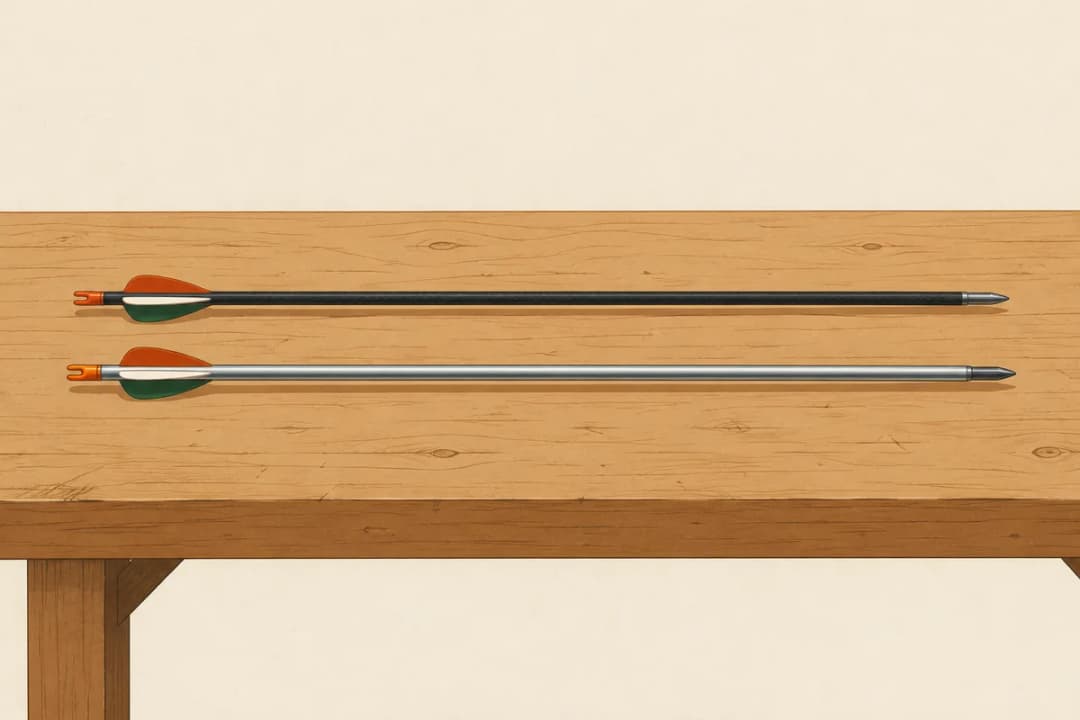


- Carbon arrows are lighter for their spine and rarely bend, but they can crack, so flex-test them before you shoot.
- Aluminum arrows are precise and easy to tune, but they bend and stay bent after a hard hit.
- For your first real set, the right spine and length for your bow matter more than the material.
- Replace the bundled kit arrows first: they’re often too long or the wrong spine for your bow, and either material beats them.
Buy carbon for your first real set. It’s more durable and forgives a miss, while aluminum is a precise, often cheaper second choice if you look after it. 👍
The catch: neither works until the spine and length fit your bow, which is why those starter arrows wobble and fishtail. Find yours with the arrow spine finder, and your groups finally show what your form is doing.
Why your first real arrows matter more than the material
My first bow came with arrows, and they were the worst part of the package. They were “way too long” and “extremely flimsy, terrible spine”, and I could see them flying left and right as they left the bow.
Replacing them with proper arrows was the change I noticed most. Today I shoot Hunter Ian and wolfman arrows, and the lesson I took from those kit arrows was that an arrow has to suit the bow it comes off.
After getting some real arrows, I was like, I'm never going back to those again, you know.
That’s why this guide starts with fit and ends with material. A well-matched aluminum arrow will outshoot a badly matched carbon one, and the reverse is just as true.
// Free printable
Get the range log I actually use.
Seventeen printable pages: session log, score tracker, a 30-day drill challenge, a bow maintenance card, a first-season checklist and more. Join the monthly email and it lands right away.
Carbon vs aluminum arrows at a glance
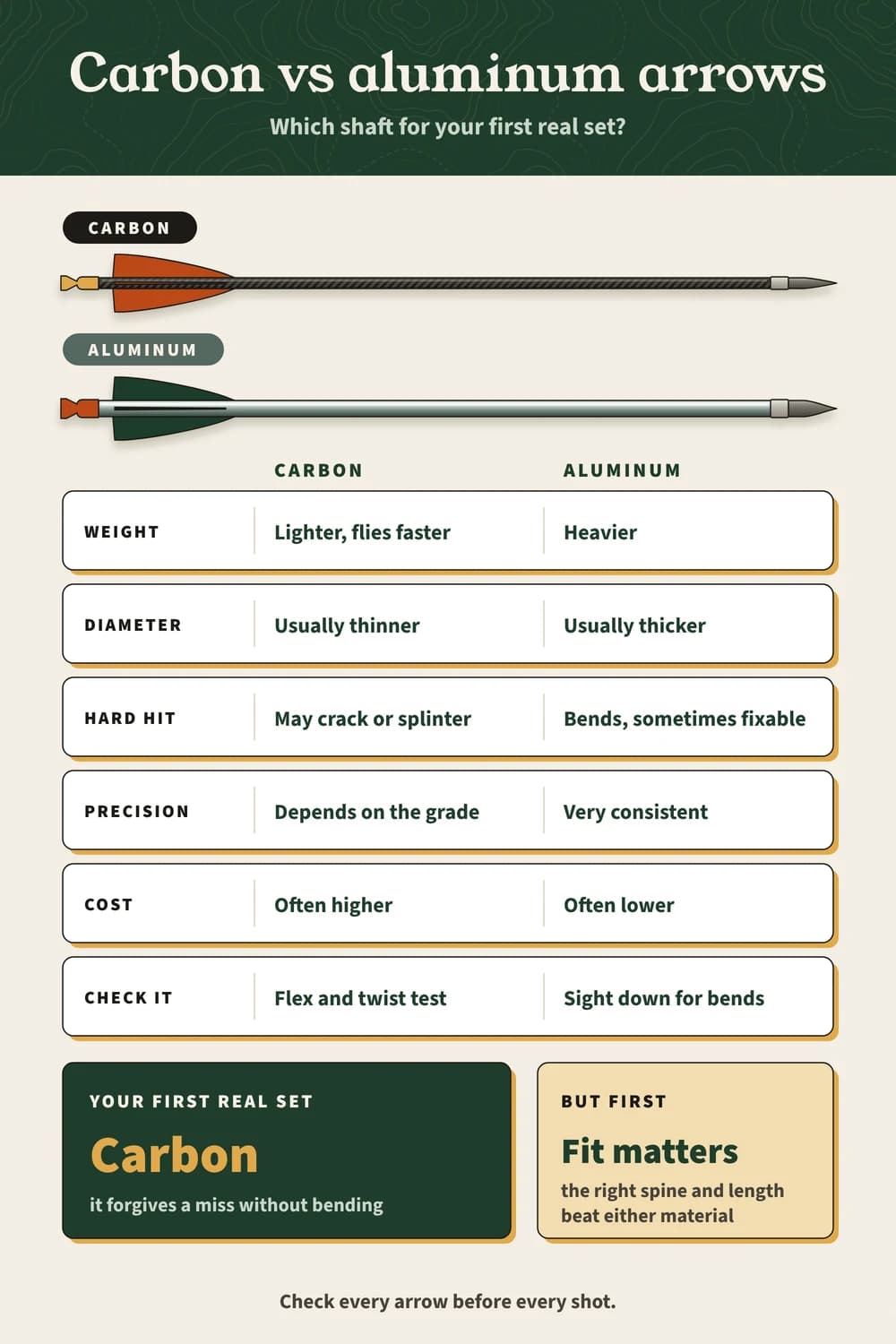
Heres how the two materials compare on the points beginners ask about most. Neither wins every row, which is why both are still sold.
| Feature | Carbon arrows | Aluminum arrows |
|---|---|---|
| Weight for the same spine | Lighter, so they fly faster | Heavier |
| Shaft diameter | Usually thinner | Usually thicker |
| After a hard hit | Usually stays straight, but can crack or splinter | Can bend; sometimes can be straightened |
| Precision | Depends on the grade; higher grades have tighter tolerances | Very consistent straightness and weight |
| Tuning a recurve | Fewer spine sizes in all-carbon shafts | Wide range of sizes and components |
| Safety check | Flex and twist test before shooting | Check straightness; retire bent shafts |
| Cost | Wide range, often higher | Often lower |
Durability: carbon arrows bend less, aluminum arrows can be straightened
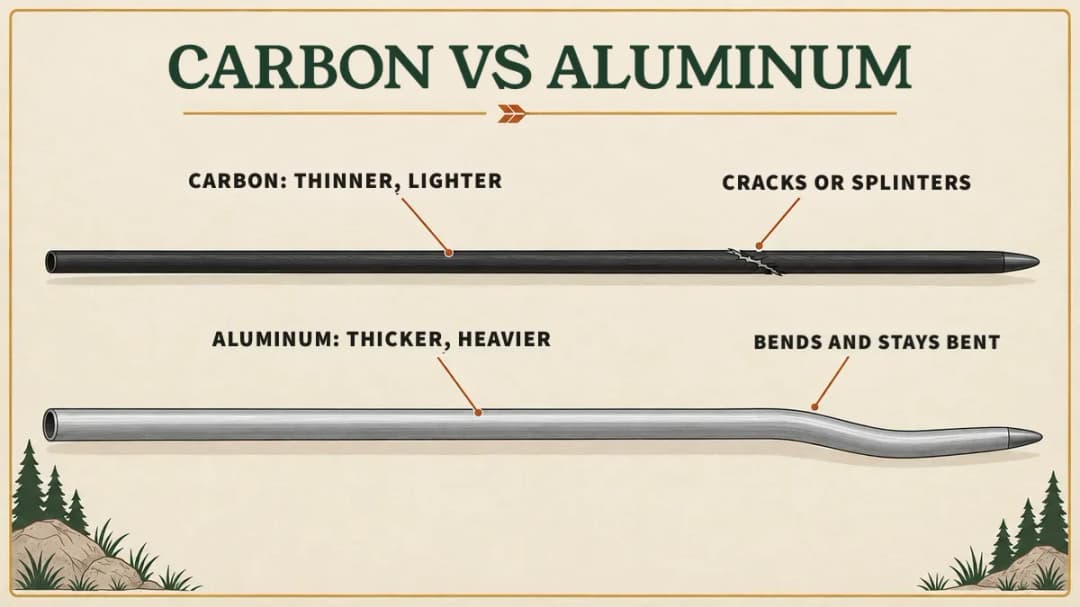
Easton, which makes both, says carbon doesn’t bend like aluminum, so straightness problems are less of a worry. When carbon fails, it cracks or splinters instead of bending.
Aluminum fails the other way, a glancing hit off a target frame or a rock can leave a shaft bent, and a bent arrow won’t fly straight until it’s straightened or replaced.
For a beginner who misses the target now and then that difference matters. I’ve lost many arrows myself, and missed shots are where arrows of either kind get damaged.
Speed and weight: why carbon arrows fly flatter
Arrow weight is listed as grains per inch (GPI). All-carbon shafts are lighter than aluminum shafts of the same spine and diameter, so they leave the bow faster and drop less over distance.
Thinner carbon shafts also catch less wind and tend to penetrate well, which is why many bowhunters use them. At 10–20 yards in the backyard, though, fit and consistency matter far more than a few feet per second.
- Carbon: flatter flight at longer distances and a thin profile in the wind.
- Aluminum: a heavier arrow for its size, and fat target shafts are easier to see and score on indoor faces.
- Aluminum-carbon hybrids (such as Easton’s X10 and ACE): an aluminum core wrapped in carbon, built for high-level target archery.
Aluminum’s real strength isn’t speed, though. 3Rivers Archery, a shop that specializes in longbows and recurves, explains why top target shooters still choose it:
The biggest advantage to aluminum actually is the consistency. Aluminum arrows are the most consistent in straightness and weight tolerances than any of the material here… High level competitive shooters usually shoot aluminum because of that.
That consistency matters at the top level, and it only shows once your form is consistent too. For your first set, a matched spine does more for your groups than the tightest tolerance.
Spine and size numbers: how to read carbon and aluminum arrow labels
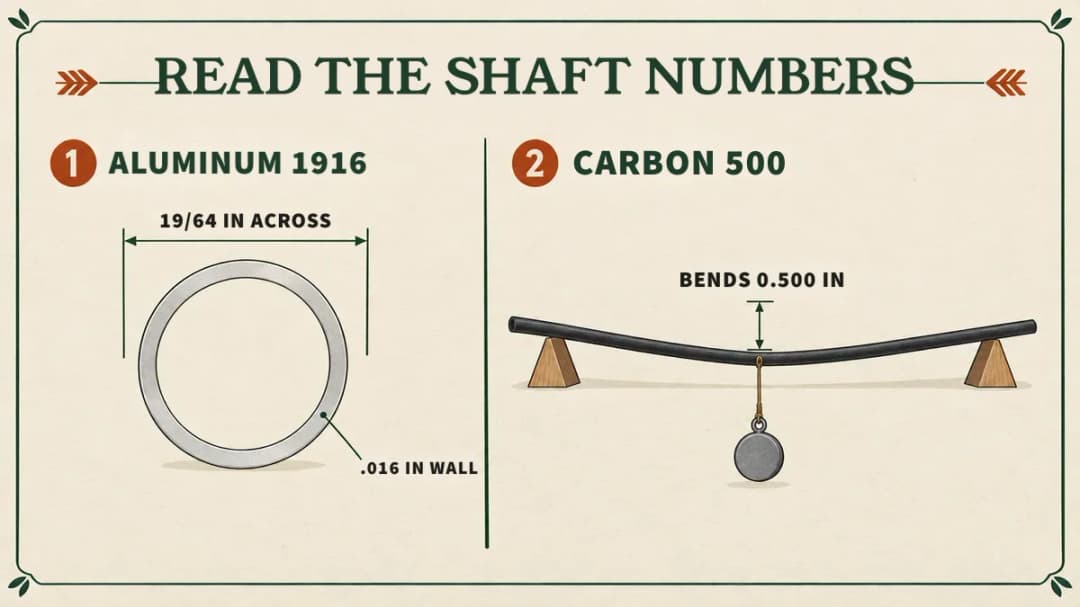
Spine is how much a shaft bends, and it has to match your draw weight, arrow length and point weight. The two materials label it differently.
- Aluminum (four digits, e.g. 1916): the first two digits are the outside diameter in 64ths of an inch, the last two the wall thickness in thousandths. A 1916 is 19/64″ (about 0.297″) across with a .016″ wall.
- Carbon (three digits, e.g. 500): the deflection under a standard test weight, times 1,000. A 500 shaft bends about 0.500″; a 400 is stiffer.
How to inspect carbon and aluminum arrows before you shoot
Easton’s usage warnings say to check every arrow before every shot. A damaged arrow can break on release and hurt you or someone near you. Gold Tip gives the same advice and says to repeat the flex test after every group and every miss.
Even the shop that recommends carbon to new archers says the checks don’t go away:
They have the lowest maintenance of these, because they cannot bend. It’s either going to be straight or broke… So you still need to do your checks, to make sure the arrow is in shooting condition.
“Straight or broke” is exactly why carbon needs the flex test: a cracked carbon shaft can look perfect. Aluminum shows you its damage as a bend; carbon hides it until you flex it.
- Feel the shaft. Roll it between your fingers and run your fingertips along its full length, feeling for nicks, cracks, splits or dents.
- Check the nock. If it’s loose, cracked or has backed out, inspect the shaft end for cracks.
- Flex carbon. Holding the shaft near the point and the nock, bend it gently about 1–2″, four to six times, turning it a little each time, and listen and feel for cracking.
- Twist carbon. If the shaft twists or “relaxes” easily, the carbon is damaged.
- Sight down aluminum. Look along a shaft or spin it on a flat surface to spot a bend.
Which arrows should a beginner buy first?
For most beginners, carbon is the easier first choice: it forgives the odd bad shot without bending, and there are plenty of entry-level shafts. Aluminum is a good pick if you want precise, tunable arrows and you’ll check them for bends.
3Rivers Archery makes the same pick for new archers, for the reason I’d give:
If you’re new to shooting I like to recommend carbon, just because it’s one less thing that you have to worry about as an archer… you just focus on your form and shooting.
Agreed, with one catch: “one less thing” only holds if the spine is right. A wrong-spine carbon arrow still flies sideways, so size it first and then stop thinking about it.
Whatever you choose, get the size right. Most guides suggest an arrow a little longer than your draw length, often about an inch, so the point stays safely in front of the bow at full draw. Measure your draw first with the draw length calculator.
If you’re still picking the bow itself, start with how to choose a recurve bow. For the rest of the kit I use, see recommended gear.
Here’s how the two compare side by side, in one picture you can save.
// FAQ
Frequently asked questions
Quick answers to the questions readers ask most.
Are carbon or aluminum arrows better for beginners?
Carbon. It rarely bends and lasts through missed shots. Aluminum is precise and easy to tune, but it bends on hard hits, so check it often.
Do carbon arrows break easily?
Not usually, but they can crack or splinter after hitting something hard. Flex-test them before shooting and throw away any shaft that cracks.
Can you straighten a bent aluminum arrow?
Sometimes. Easton notes aluminum arrows can sometimes be straightened, but a badly bent shaft should be retired.
Are aluminum arrows good for a recurve bow?
Yes. Aluminum offers a wide range of spine sizes, which makes tuning a recurve easy, and fat aluminum shafts are still popular for indoor target archery.
Why do my arrows fly sideways?
Often the arrow is the wrong spine or length for your bow, or your form needs work. Check your arrows against a spine chart first, then work on your archery stance and release.
What spine arrow do I need?
The one the maker’s spine chart gives for your draw weight, draw length, arrow length and point weight. Look it up for your exact shaft, or start with the arrow spine finder.

Final thoughts
Buy carbon for your first real set, and get the spine and length right before you worry about material. Carbon is lighter for its spine and harder to bend; aluminum is precise, easy to tune and a fine second choice if you check it for bends.
Get them fitted, inspect them every session, and retire damaged shafts. Then track your groups in my free range log to see what the right arrows do for you.
