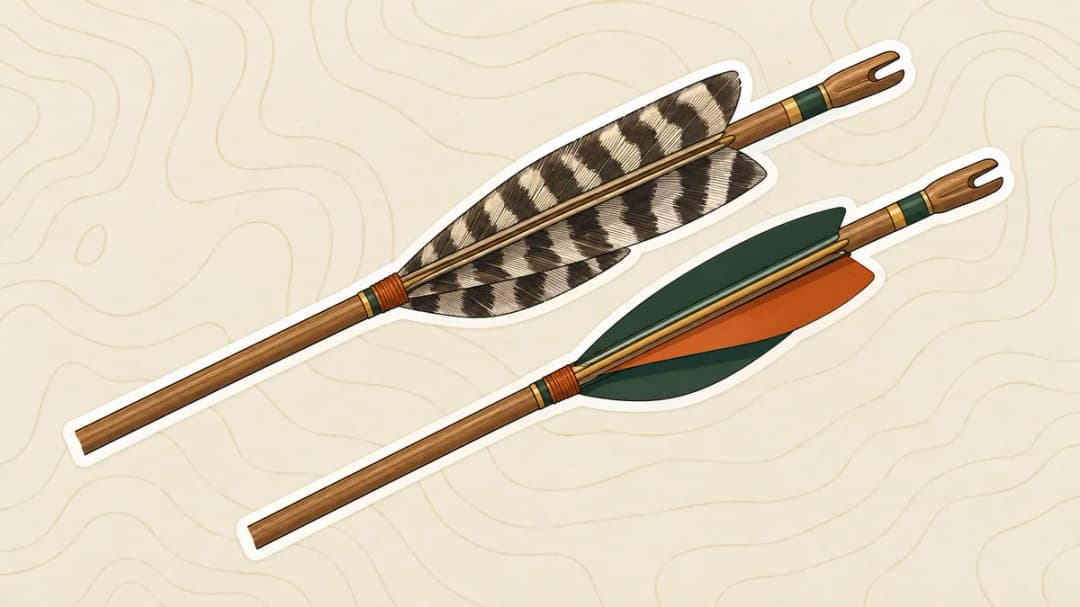


- Pick by your rest first: feathers off the shelf, vanes on a raised rest, and the rest of the choices follow.
- Feathers are light and fold out of the way, so they suit shooting off the shelf of a traditional bow.
- Vanes are plastic, tougher and fine in the rain, which is why most compound and crossbow arrows use them.
- Offset is the all-round pick for practice; helical spins hardest and straight loses the least speed.
- A quick powder test shows whether your fletching is hitting the rest or riser.
Feathers or vanes, straight or helical, three fletch or four? It feels like a test you didn’t study for. 😅
Fletching is the set of fins that steers an arrow and spins it, and one rule settles most of it: feathers if your arrow rests on the shelf, vanes if you use a raised rest, with a little offset for steady flight. Match the arrow itself first with the arrow spine guide, and your groups show your form, not your gear.
How fletching steers your arrow
Fletching works like the feathers on a dart. As the arrow flies air pushes on the fins at the back, which keeps the point leading and pulls the arrow straight after it flexes off the bow.
Angled fletching also makes the arrow spin, which steadies it the way a spiral steadies a football. More spin means a steadier arrow, but also a little more drag.
Fletching can’t fix an arrow that doesn’t suit your bow, though. Get the spine right first (the arrow spine guide shows how), then fine-tune with fletching.

// Free printable
Get the range log I actually use.
Seventeen printable pages: session log, score tracker, a 30-day drill challenge, a bow maintenance card, a first-season checklist and more. Join the monthly email and it lands right away.
The index vane: nock every arrow the same way
Most arrows carry three fletches spaced 120 degrees apart. One of them is a different color: that’s the index vane (or cock feather), and the other two are called hen fletches.
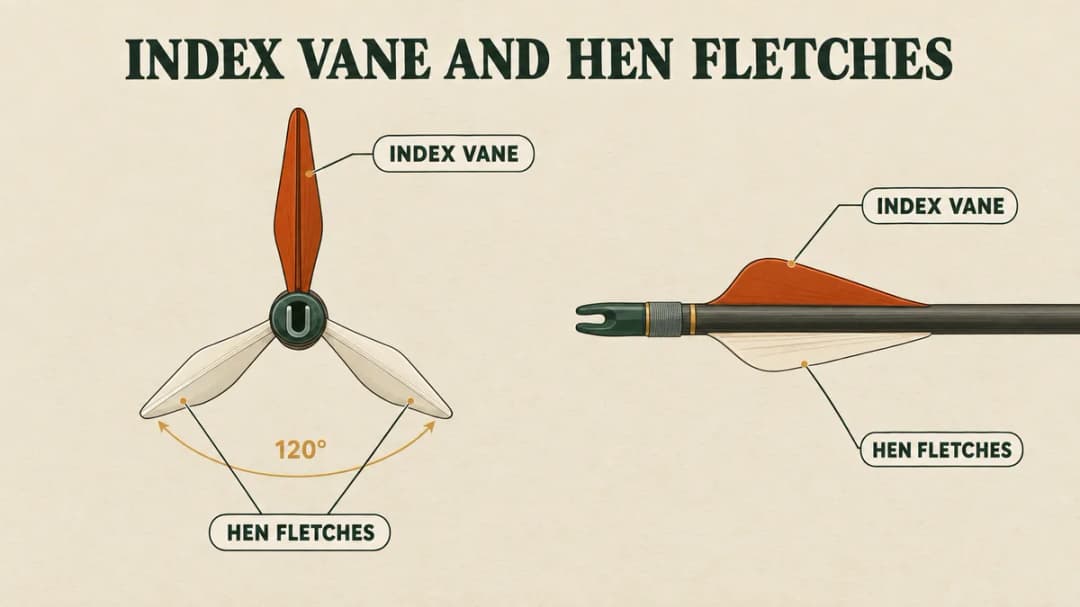
The odd color is there so you nock every arrow the same way, with the index vane in the same position each shot. Some archers use four fletches spaced 90 degrees apart, which adds steering for heavier hunting points.
- Index vane: the odd-colored fletch that shows you how to nock the arrow.
- Hen fletches: the two matching fletches beside it.
- Four fletch: four fins at 90 degrees, more steering and a little more drag.
Feathers vs vanes: which fletching suits your bow
Feathers are real bird feathers, and vanes are molded plastic. The big difference is what happens when the fletching brushes the bow: a feather folds and springs back, while a vane deflects the arrow.
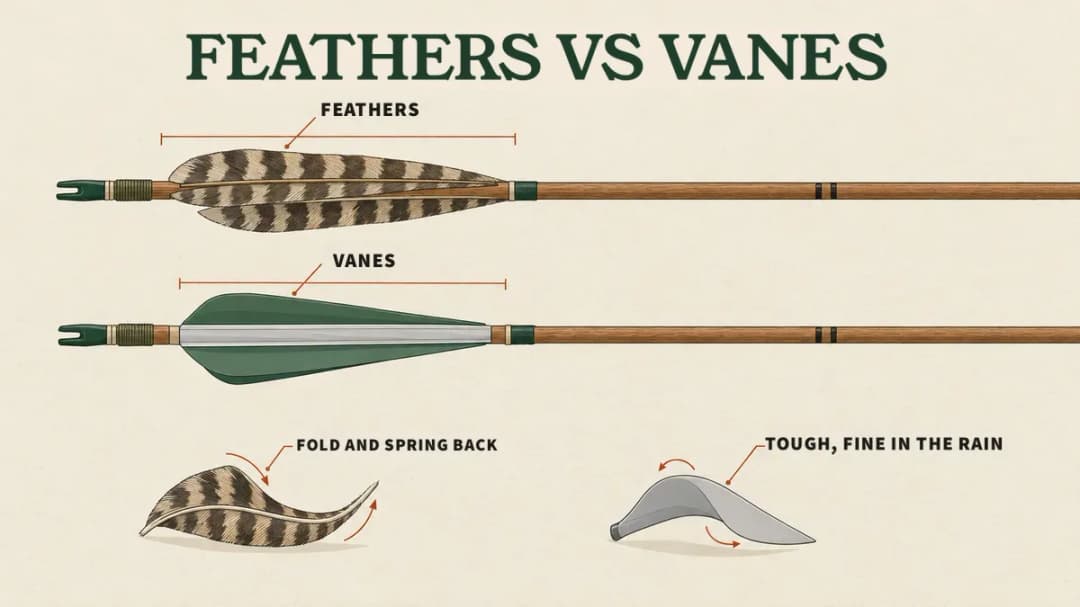
That’s why feathers are the go-to for shooting off the shelf of a traditional recurve or longbow, and vanes suit bows with a raised rest that keeps them clear. Vanes shrug off rain, last longer and run quieter, while feathers are lighter and can lose their shape when wet unless their waterproofed.
| What matters | Feathers | Vanes |
|---|---|---|
| Brushing the bow or rest | Fold and spring back | Push the arrow off line |
| Weight | Lighter | Heavier (up to about 3× a feather of the same size) |
| Rain | Can flatten unless waterproofed | Not affected |
| Durability | Wear out and need replacing | Last much longer |
| Noise | Louder | Quieter |
| Best for | Shooting off the shelf | Raised rests, compounds, crossbows |
Straight, offset or helical: how much spin you need
The angle the fletching is glued at decides how much the arrow spins. Straight fletching barely spins it, offset adds a slight angle, and helical curves around the shaft for the most spin.
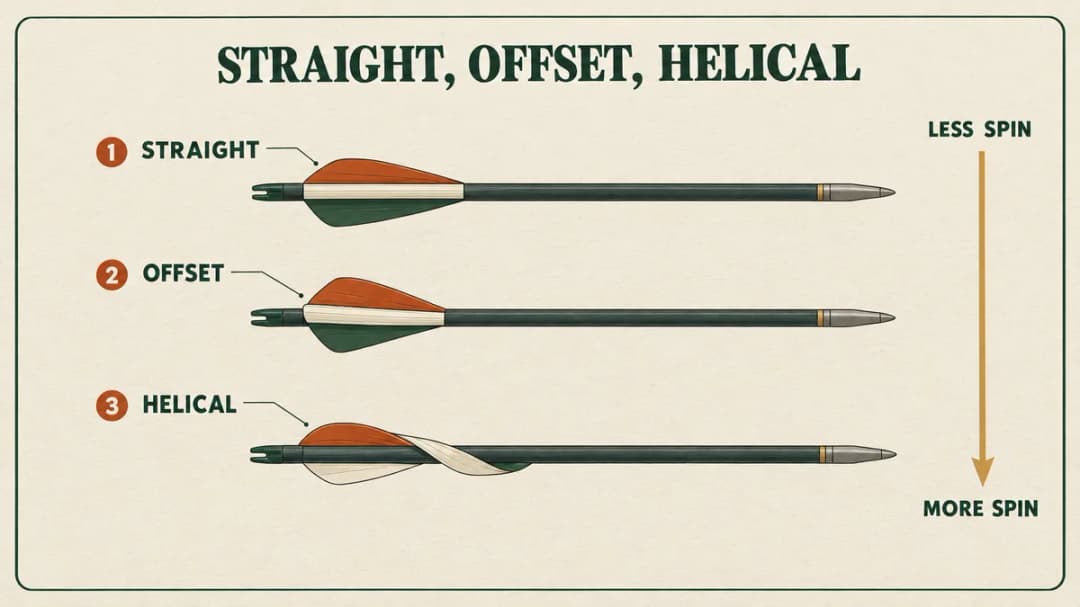
- Straight: least drag and the least spin; fine for target points and many expandable hunting heads.
- Offset: a slight angle for more spin with only a small speed cost; a good all-round choice.
- Helical: the most spin and steadiest flight, especially with fixed-blade broadheads, but the most drag and more tuning for clearance.
For target practice at normal ranges, offset or a mild helical is plenty. And the speed you give up is small at the distances most beginners shoot.
Average Jack Archery, a pro shop and range, explains the difference in a two-minute tip, and gives the number most store arrows use:
An offset is a little less aggressive than a helical… This is the industry standard of a simple 1 to 2 degree offset.
That small angle is why I call offset the all-round pick. One or two degrees is enough spin for practice arrows, and since it’s the industry standard, you rarely need to order anything special.
Which fletching for your setup: a quick guide
Put the three choices together and most setups land on one obvious answer. Start here, then change one thing at a time if your arrows don’t fly clean.
| Your setup | Material | Angle |
|---|---|---|
| Recurve or longbow, shooting off the shelf | Feathers | Offset or helical |
| Recurve with a raised rest | Small vanes or feathers | Offset |
| Compound with field points | Vanes | Straight or offset |
| Hunting with fixed-blade heads | Vanes or feathers | Helical |
| Crossbow | The bolt maker’s vanes | As supplied |
Why does the table put helical feathers on a shelf-shooting bow? The same video explains who loves them:
This is really popular with people who shoot traditional equipment, particular those who shoot a longer fletching, either plastic vane or a longer feather. They really like that helical. It really grabs a lot of air, has a lot more drag to the back end.
That drag is the price of the steadier flight. At backyard distances you won’t miss the speed, and a long helical feather forgives a release that isn’t perfect yet.
Fletching size, and what crossbow bolts use
Longer and taller fletching steers harder, which helps heavy or bladed points fly straight. Smaller, low-profile vanes cause less drag and wind drift, which is why target arrows often carry short vanes.
Crossbow bolts nearly always use plastic vanes, often about 2–3 inches long and low profile so they clear the crossbow’s rail and string. Use the bolt length, weight and nock your crossbow’s manual lists, and keep the factory vanes.
The powder test: is your fletching hitting the bow?
If arrows kick or fly erratically, the fletching may be brushing the rest or riser. A dusting of powder shows it in one shot.
- Dust the back half of an arrow, fletching included, and the rest area with baby powder or a foot-powder spray.
- Nock it carefully without rubbing the powder off, and shoot it into the target.
- Look for wiped-off powder on the fletching, the shaft and the rest.
- Adjust and repeat: rotate the nock if a fin hits the rest, and ask a shop about the nocking point or rest position if the marks persist.
How to tell your fletching needs fixing
Check your fletching every time you pull arrows, because a damaged fin changes how the arrow flies. Replace or refletch an arrow when a fin is torn, peeling at the base or flattened.
- Vanes: look for tears, nicks and edges lifting off the shaft.
- Feathers: look for splits, bald patches and feathers that stay flat.
- Index vane: if it’s missing, you can no longer nock that arrow the same way.
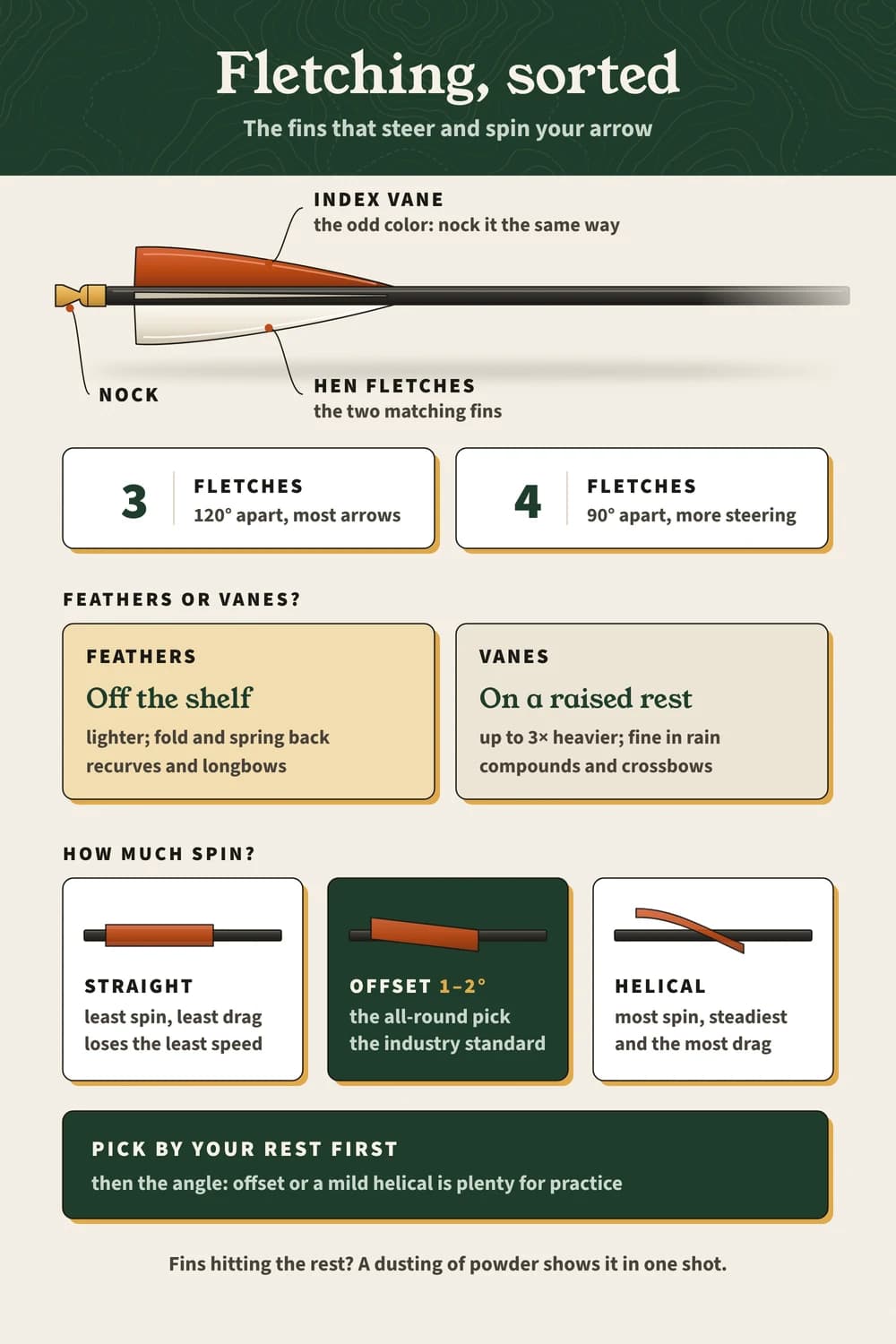
Here’s fletching on one page, to check before you order arrows.
// FAQ
Frequently asked questions
Quick answers to the questions readers ask most.
How do I know if my fletching hits my bow?
Do a powder test: dust the fletching and rest, shoot one arrow and look for wiped marks. Rotating the nock often fixes it.
Are feathers or vanes better for beginners?
Feathers if you shoot off the shelf of a recurve or longbow; vanes if you use a raised rest or a compound.
Why is one vane a different color?
That’s the index vane. It shows you how to nock the arrow so every arrow sits on the string the same way.
Does helical fletching slow an arrow down?
A little, because the extra spin adds drag. At typical practice distances the difference is small, and the steadier flight is usually worth it.
Can you shoot an arrow with a damaged vane?
You shouldn’t, because it changes how the arrow flies. Set it aside and refletch it or replace it.

Final thoughts
Fletching comes down to two choices: feathers or vanes for your rest, and how much spin you want. Match those to your bow and the rest is checking your fins every session.
Write down which arrows fly best in the free range log, and you’ll quickly see if a set needs new fletching.
