

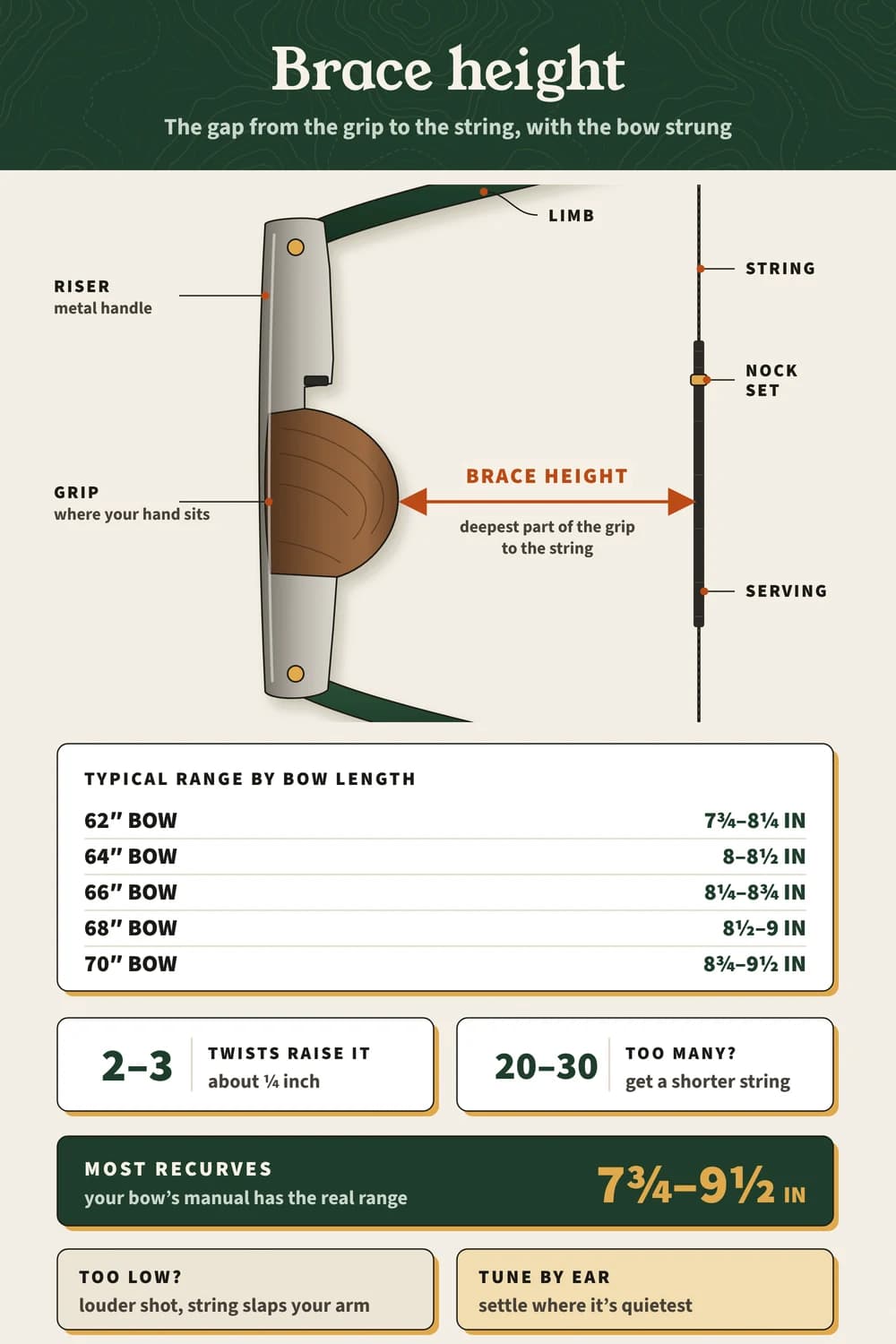
- Most recurves sit around 7¾ to 9½ inches, depending on length; your bow’s manual has the real range.
- Measure it with a bow square every time you string the bow, because strings stretch.
- To raise it, unstring and add twists to the string; remove twists to lower it.
- Tune by ear: within the maker’s range, settle on the setting where the bow sounds quietest.
- More than about 20–30 twists means you need a shorter string, not more twisting.
A louder twang, a string slapping your arm guard, and your form hasn’t changed at all. The culprit may be a gap of a few inches. 🧐
Brace height is the distance from the string to the deepest part of the grip, and a string that has stretched too low makes a bow noisy and hits your arm. Measure it in a minute with a bow square, use a bow stringer to take the string off, and bring it back into range.
How brace height changes the way your bow shoots
Brace height is measured in a straight line from the deepest part of the grip (the pivot point, where your hand presses) to the string, with the bow strung but not drawn. It sets how long the string stays in contact with the arrow as you shoot.
That changes three things you’ll notice: noise, string slap and how forgiving the bow feels.
- Noise: too high or too low and the bow sounds harsh and buzzes in your hand.
- String clearance: a low brace height brings the string closer to your forearm, so it slaps your arm more.
- Arrow flight: brace height changes how the arrow leaves the string, so it also affects tuning and arrow spine.
// Free printable
Get the range log I actually use.
Seventeen printable pages: session log, score tracker, a 30-day drill challenge, a bow maintenance card, a first-season checklist and more. Join the monthly email and it lands right away.
How to measure brace height with a bow square
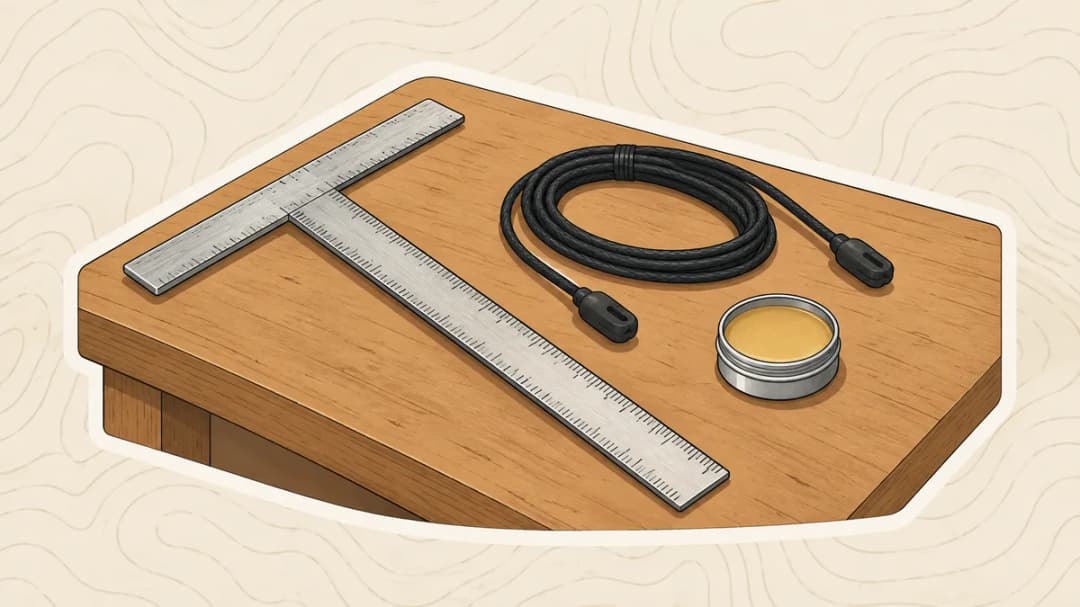
A bow square is a T-shaped ruler made for this job. The short crossbar clips onto the string and the long arm has an inch scale that starts at the crossbar.
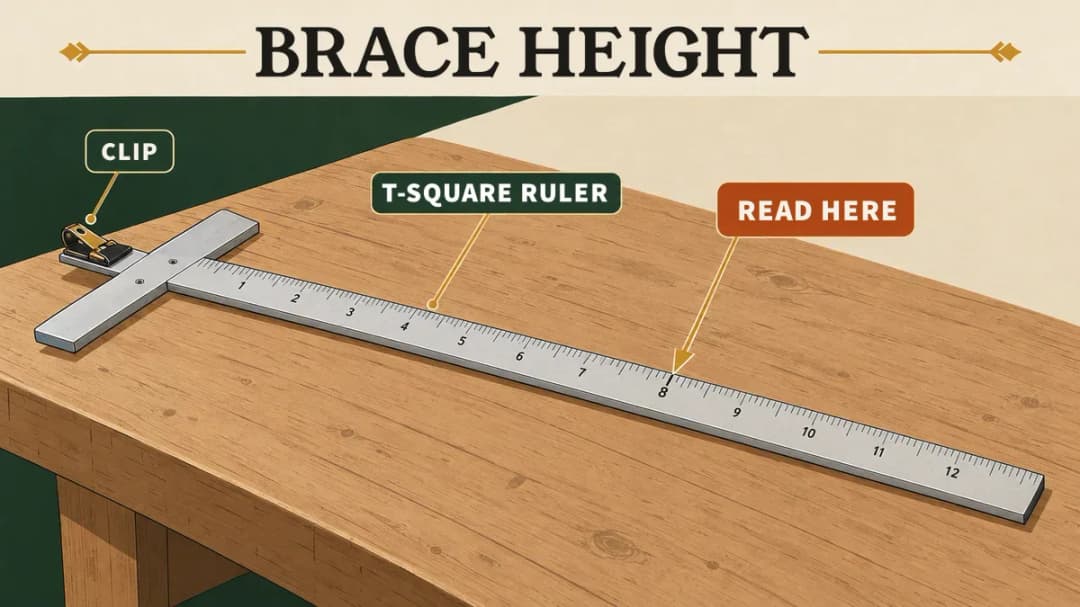
- String your bow with a bow stringer and let it settle for a few minutes.
- Clip the crossbar onto the string, so the long arm points toward the grip.
- Hold the long arm square to the string (a right angle) and rest it on the deepest part of the grip.
- Read the number where the arm meets the grip. In the picture above, that’s 8 inches.
Archery 360, the Archery Trade Association’s channel, has a short video on exactly this job, and it opens with the reason to bother:
The reason why brace height is an important measurement and something you want to check often is because we want to have a consistent brace height every time we go shooting. Brace height is going to affect where your arrows impact on the target as well as your tune.
That second sentance is the one beginners miss. If your brace height moves, your arrows move, and you’ll blame your release for a change that happened on the string.
What brace height your recurve should read
Every bow maker lists a recommended range for each model and length. Start with the range in your bow’s manual; if you can’t find it, these general ranges for recurves are a good guide.
| Recurve length | Typical brace height |
|---|---|
| 62″ | 7¾–8¼″ |
| 64″ | 8–8½″ |
| 66″ | 8¼–8¾″ |
| 68″ | 8½–9″ |
| 70″ | 8¾–9½″ |
Longbows and shorter one-piece bows usually run lower; the old fistmele rule (a fist with the thumb stuck out, about 6 to 7 inches) comes from longbows. Never shoot a bow outside its maker’s range.
How to change brace height by twisting the string
On a recurve or longbow you change brace height by twisting the string. Twists shorten it a little, which raises the brace height; untwisting lowers it.
- Unstring the bow with your bow stringer.
- Add 5 to 10 twists in the same direction as the string’s existing twist to raise it, or take some out to lower it.
- Restring and measure again, then repeat until you’re in range.
How many twists is “a few”? The same video puts a number on it:
Let’s say we want to get to that seven and three quarter brace height but our brace height is at seven and a half inches. What we’ll do is we’ll add two or three twists and that should give us that quarter inch we’re looking for.
That’s the scale worth remembering: a quarter inch is only two or three twists. Make small changes, restring, measure, and you’ll soon know how your own string responds.
Tune your brace height by ear for a quieter bow
Inside the maker’s range there’s usually one setting where the bow sounds and feels best. Finding it takes one session and a handful of arrows.
- Start at the bottom of your bow’s range and shoot a few arrows, listening to the sound.
- Add about four twists, measure again and shoot the same number of arrows.
- Keep going until you reach the top of the range, then settle on the quietest setting.
- Write the number down, so you can set it again after a new string.
Archery 360 frames the whole range the same way:
You wanna figure out where in that suggested brace height range your bow shoots the best.
I’d add one thing for a newer archer: quiet and comfortable is the right target. Group size changes from shot to shot while your form is settling, but the sound of the shot tells you right away.
Brace height problems: what you notice and what to do
A drifting brace height shows up as something you hear or feel before you ever measure it. Measure first, then fix the number.
| What you notice | Likely brace height | What to do |
|---|---|---|
| String slapping your forearm more than before | Too low | Add twists until you’re back in range |
| A louder, harsher shot | Too low or too high | Measure, then tune by ear inside the range |
| Brace height dropping each session | A new string still stretching | Recheck every time you string up until it settles |
| Can’t reach the range even with 20–30 twists | String too long | Buy a shorter string for your bow’s length |
Once your brace height is set, check your arrow rest and nocking point, and keep the string waxed (how to wax a bowstring). A bow set up the same way every session is one you can trust.
Here’s brace height on one page: where to measure, the usual range for your bow length and how to adjust it.
// FAQ
Frequently asked questions
Quick answers to the questions readers ask most.
Is a higher or lower brace height better?
Neither: stay in your bow’s range and settle where the bow sounds quietest. Lower is a little faster but slaps the arm more; higher is quieter and more forgiving.
Why is my bow so loud?
A brace height that is too low or too high is a common cause. Check it first, then look at loose accessories.
How often should I check brace height?
Every time you string the bow, and more often with a new string, which stretches at first.
Which way do I twist the string?
The same direction as the twist already in it. Twisting the other way unwinds it and lowers the brace height.
Final thoughts
Brace height is one number, and it’s easy to check. Measure it every time you string up, keep it in your bow’s range, and twist the string to adjust it.
Write your bow’s brace height in the free range log so you notice when it drifts.
