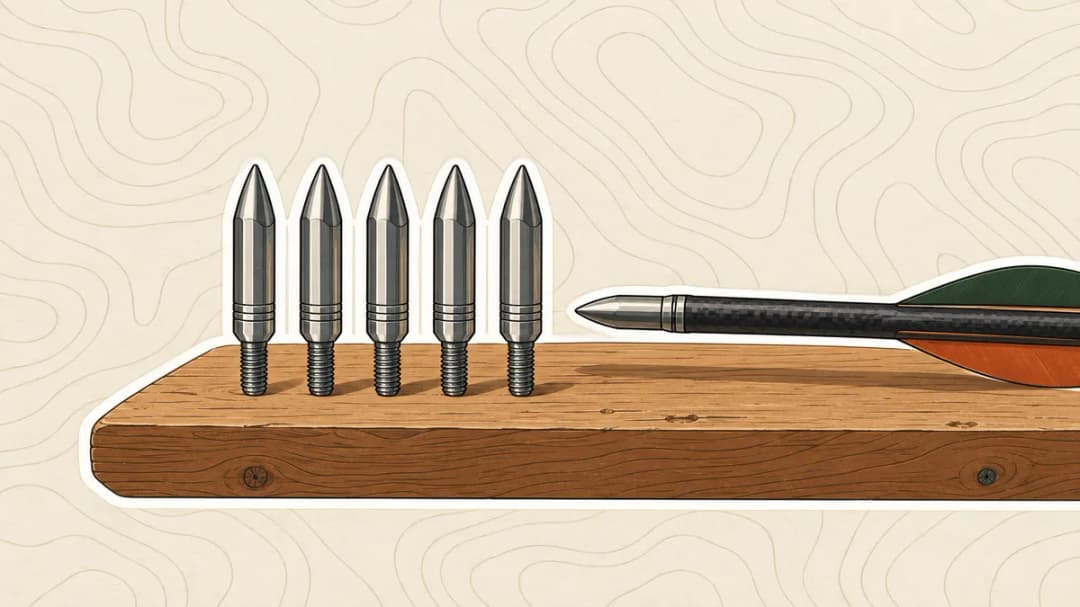


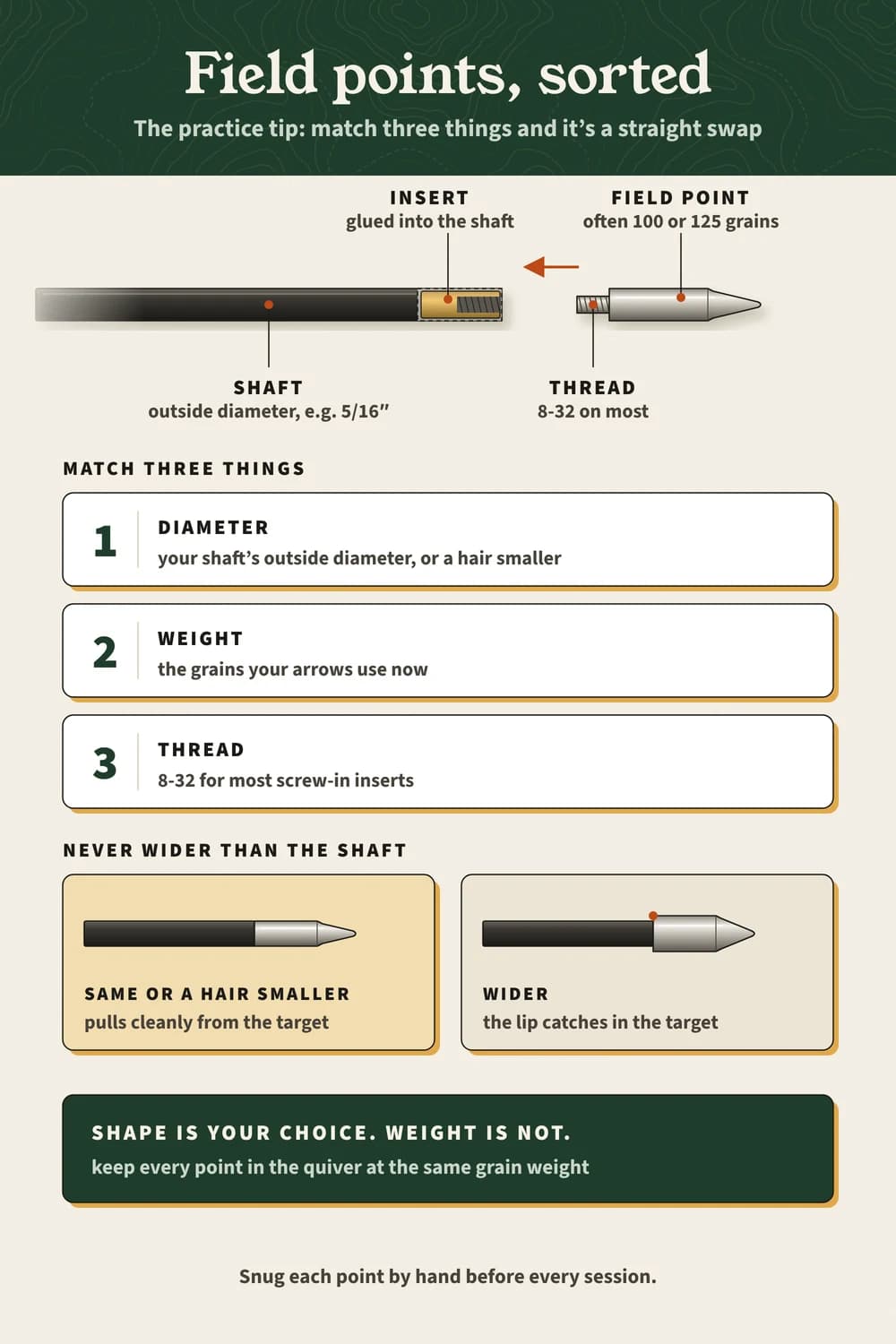
- Buy points that match three things: your shaft’s outside diameter, the grain weight you shoot now and the 8-32 thread.
- Don’t change point weight casually: a heavier point makes the arrow act weaker and moves where it lands.
- Check every point is snug before each session; a loose point changes flight and can stay in the target.
- If you hunt, practice with field points that weigh the same as your broadheads.
The store clerk asks: what weight, what diameter, what thread? And you just wanted more of the points your arrows came with. 😅
Field points are the plain practice tips that pull cleanly out of targets, and the right ones match your shaft’s diameter and the weight your arrows already use, usually 100 or 125 grains. I wrote up the 100-grain field tips I shoot.
How field points attach: screw-in, glue-on or glue-in
Most carbon and aluminum arrows have an insert glued into the front of the shaft. Screw-in field points thread into that insert, and almost all of them use the same 8-32 thread.
- Screw-in: threads into the insert; swap points in seconds.
- Glue-on: slides over the end of a tapered wood shaft and is glued on.
- Glue-in: some thin carbon shafts take points glued straight into the shaft.
// Free printable
Get the range log I actually use.
Seventeen printable pages: session log, score tracker, a 30-day drill challenge, a bow maintenance card, a first-season checklist and more. Join the monthly email and it lands right away.
How to choose field points: 3 checks at the store
Field points are sold by diameter, weight and thread. Get all three right and the new point’s are a straight swap.
| Choice | What to match | Why it matters |
|---|---|---|
| Diameter | Your shaft’s outside diameter (e.g. 5/16″, 9/32″), or a hair smaller | A point wider than the shaft catches in the target |
| Weight | The points your arrows use now (often 100 or 125 grains) | Changing weight moves where arrows land |
| Thread | 8-32 for most screw-in inserts | The standard insert thread |
| Shape | Field, bullet or rounded nose | Any shape works at the same weight; some pull out easier |
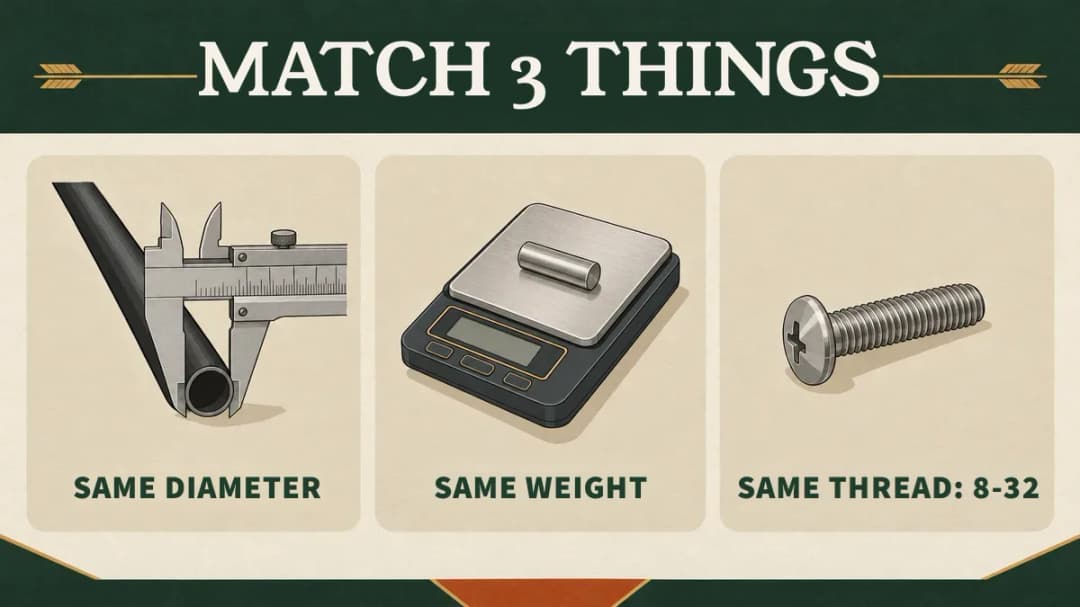
Find your diameter on the shaft or the box: most arrows print their model and size on the shaft, and the maker’s chart gives the outside diameter. Points are sized in small steps, so never buy one wider than the shaft: the lip catches in the target.
Average Jack Archery, a Pennsylvania pro shop and range, makes the diameter point better than any spec sheet:
Make sure your field point is not bigger than the outside diameter of your insert because when you go to pull your arrow out of your target that lip of that extra wide field point is gonna catch on the inside of the foam or of the layers of your bag target and it’s gonna be a bear to pull out… So your field point could be smaller in diameter or the exact same size, just make sure it’s not too big.
That’s the rule I’d shop by: the same size or a hair smaller, never bigger. If the store doesn’t have your exact diameter, step down, not up.
Point weight: when to stay put and when to change
A heavier point makes the arrow act weaker in spine and pushes the balance point forward. That’s why the safe default is the weight your arrows were set up with.
- Stay put if your arrows fly well and group: new points at the same weight change nothing.
- Go lighter only if your arrows act too weak for your bow and a shop or the arrow spine finder says so.
- Go heavier to bring a stiff arrow into tune or to raise front-of-center balance; Easton suggests about 10–15% FOC for outdoor arrows.
Check your balance with the FOC calculator before you buy a new weight. Change one thing at a time, then shoot a few ends to see what it did.
Fitting and caring for field points
Field points are tough, which matters when you’re learning. Arrows get lost, as I found out early:
I've lost many arrows. I don't know where they went. I tried my best to find them, but that's just the way it goes.
The points you keep last longer with a minute of care. These are the habits worth having.
- Screw each point in snug by hand, until it seats flush against the insert.
- Check them before every session; a point that has backed out a turn changes flight and can stay behind in the target.
- Pull arrows along the line they went in, gripping the shaft close to the target with your other hand flat on the target face, so you don’t bend the shaft.
- Removing a glued point: heat it gently until the glue softens, then pull it with pliers; never overheat a carbon shaft.
Point shape is the one thing you can mix. In the same video he shoots six different 100-grain shapes into one target at about 20 yards and checks the group:
I would say no, it doesn’t matter. The aerodynamics, they’re all field points, they’re all incredibly streamlined, incredibly aerodynamic.
That’s the useful split: shape is your choice, weight is not. Pick a nose that pulls easily from your target. And keep every point in the quiver at the same grain weight.
Practicing for hunting: match your field points to your broadheads
If you hunt your practice arrows should fly like your hunting arrows. Use field points that weigh the same as your broadheads, on arrows of the same length.
That way your sight or aim stays the same when you switch heads for the season. Shoot a few broadheads before the season too, because they can still land a little differently.
Before you head to the store, here's the whole field-point checklist on one page.
// FAQ
Frequently asked questions
Quick answers to the questions readers ask most.
What grain field point should I use?
The same weight your arrows came with, most often 100 or 125 grains. Changing weight changes where your arrows land and how stiff they act.
Are field points and target points the same?
Mostly. Both are blade-free practice tips; “bullet” points just have a rounder nose. Either works for target practice.
What thread do field points use?
Almost all screw-in points use an 8-32 thread that fits standard inserts. A few arrow systems use their own size.
Why do my field points keep coming loose?
Snug them by hand before each session. If one still backs out, the insert itself may be loose, so have a shop re-glue it.
Can I hunt with field points?
No. Field points are for practice and targets; hunting game needs a proper broadhead and the rules in your state.

Final thoughts
Field points are the easiest part of an arrow to get right: same diameter, same weight, same thread, and your new points shoot like the old ones.
Keep a few spares in your quiver, and note any weight change in the free range log so you can see what it did.
