

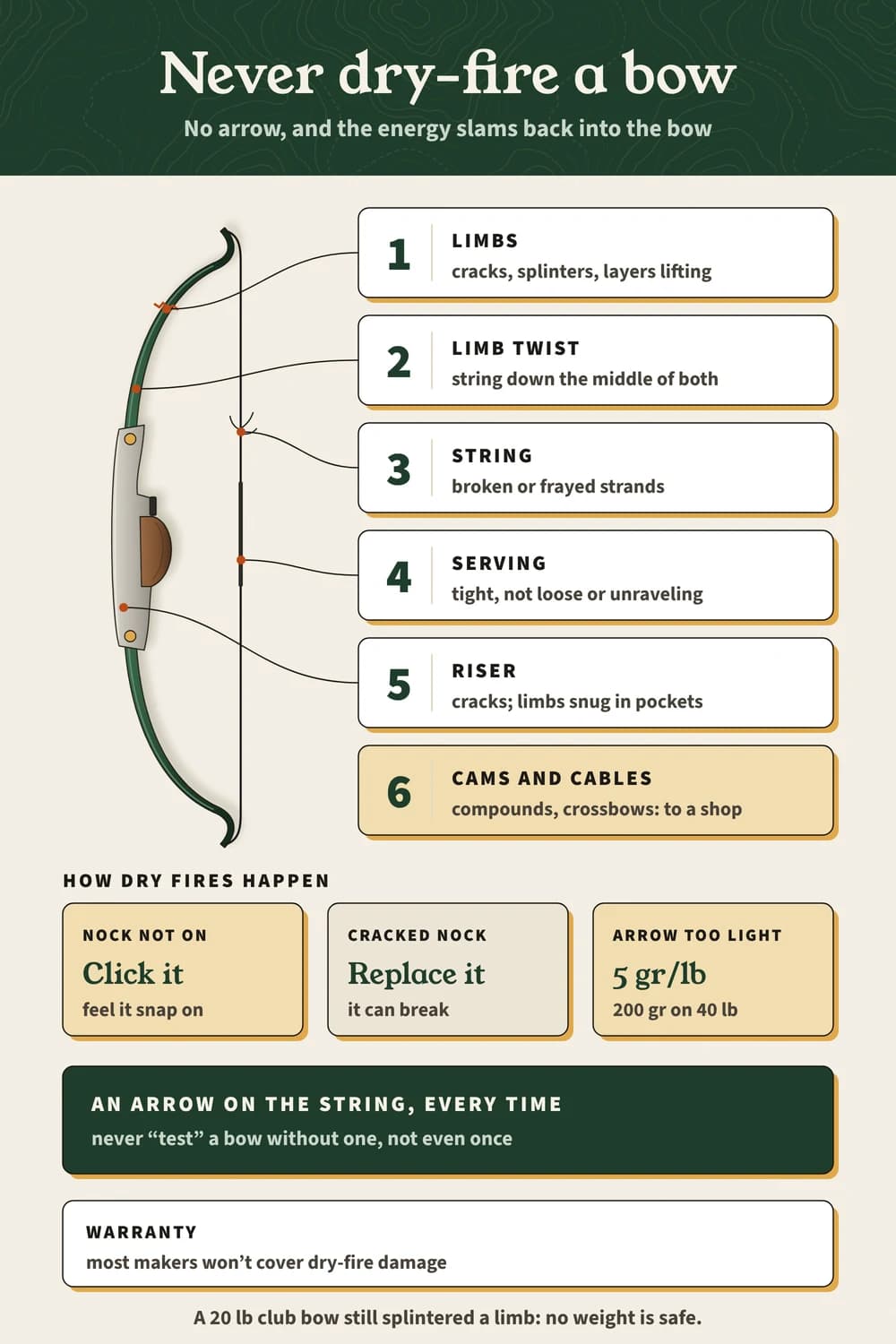
- Never dry-fire a bow. Not once, not “just to feel it”: with no arrow on the string, all the energy goes back into the bow.
- A dry fire can crack limbs and break the string, and on compounds and crossbows it can bend cams and axles.
- Most makers won’t cover dry-fire damage under warranty, so the repair is on you.
- After a dry fire, stop shooting, run the six checks below, and let a shop inspect anything doubtful.
- Most dry fires are accidents: a nock not snapped on, a cracked nock, or an arrow far too light for the bow.
Crack. No arrow on the string, and heads turn all down the range. 😱
A dry fire (letting go of the string with no arrow on it) sends all the stored energy into the limbs and string, so stop shooting until you’ve run the six checks below, and let a shop look at anything odd. The beginner’s guide covers the range rules that keep it from happening twice.
Why a dry fire is so hard on a bow
Normally the arrow carries most of the bow’s stored energy away. Without it, that energy slams back into the limbs, string and riser as one violent jolt.
That’s why bow makers treat it as abuse, not an accident to shrug of. Hoyt’s recurve warnings say a dry fire can cause severe damage to the bow and injure the shooter or people nearby, and that the damage isn’t covered under warranty.
I did it once, at the range. Nobody panicked, but everyone around me was really concerned, and that’s how I learned it’s a big no-no: a dry fire can break the bow.
I actually did a dry fire and the whole range was like whoa.
NUSensei, an archery coach who runs one of the best-known archery channels, explains it with a club bow that a new archer had just dry-fired:
However, when there’s no arrow loaded onto the string, there’s no place where the energy is to be transferred. So the energy goes back into the limbs. And the limbs aren’t made to handle that kind of stress from that direction.
His example was a 20 lb club bow, and the limb still splintered. If a light beginner bow can crack, there’s no draw weight at which a dry fire is safe.
// Free printable
Get the range log I actually use.
Seventeen printable pages: session log, score tracker, a 30-day drill challenge, a bow maintenance card, a first-season checklist and more. Join the monthly email and it lands right away.
Dry fire damage: what can break on each kind of bow
The heavier the bow and the more moving parts it has the worse a dry fire gets. Compounds and crossbows are the most at risk, but a simple recurve stores plenty of energy too.
| Bow | What a dry fire can damage | Why it’s at risk |
|---|---|---|
| Recurve or longbow | Cracked or splintered limbs, a broken string, damage to the riser | The limbs absorb the shock the arrow should have taken |
| Compound | Cracked limbs, bent axles, warped cams, a derailed or broken string and cables | High tension and many moving parts |
| Crossbow | The same parts as a compound, and it voids the warranty on major brands | Even higher draw weights |
Not every dry fire destroys a bow, and some look fine afterwards. That’s the trap: a crack you can’t see yet can let go on a later shot, so treat every dry-fired bow as damaged until it’s been checked.
What to check after a dry fire, before your next arrow
Put the bow down and go over it in good light before anything else. On a recurve, unstring it with a bow stringer so you can see the limbs; leave a compound or crossbow strung and take it to a shop.
- Limbs: look along both faces and edges for cracks, splinters or layers lifting apart, above all any crack that runs across the limb.
- Limb twist: string the bow again and sight down the string; it should run down the middle of both limbs.
- String: look for broken or frayed strands. A frayed string gets replaced, not shot.
- Serving: the wrap in the middle of the string should be tight, not loose or unraveling.
- Riser: check it for cracks, and on a takedown make sure each limb still sits snug in its pocket.
- Cams and cables (compounds, crossbows): a derailed string or a bent cam means the bow goes to a shop.
A visual check can miss damage inside a limb. If the bow is a compound or crossbow, or it sounds or feels different afterwards, a shop can check it properly and spot what your eyes miss.
And he’s just as clear about what to do afterwards, even when the bow looks fine:
Even if nothing happened to your bow, it’s best to get it checked out at the shop. The reason is, there’s a high chance there are micro fractures in your limbs.
I agree, with one practical note. A compound or crossbow goes to a shop, no question; on a simple recurve, run the six checks first, and take it in if anything looks or sounds different.
How dry fires happen, and the habits that prevent them
Almost nobody dry-fires on purpose. Most dry fires come from an arrow that wasn’t really on the string, or one far too light for the bow.
- Snap the nock on every time: you should feel it click onto the string. If you draw and let down, re-snap it before you draw again.
- Replace cracked or loose nocks: a cracked nock can break on the shot and turn it into a dry fire.
- Respect the minimum arrow weight: Hoyt says never shoot a recurve arrow lighter than 5 grains per pound of draw weight, so 200 grains on a 40 lb bow; the arrow grain guide shows how to weigh yours.
- Never “test” a bow without an arrow: not for a friend, not in the shop, not once.
- Crossbows: unload by shooting: to uncock one, shoot a bolt into a target as the manual says; never dry-fire it (more in loading and unloading a crossbow).
One habit most guides skip, and NUSensei puts first:
The main risk however, is not you. It’s when other people handle your bow.
That’s the rule I’d tape to every bow rack. Nobody picks up and draws your bow without asking, friends included, and if they do hold it, watch them until it’s back down.
If it ever happens, this is the page to pull up before your next arrow: the six checks and the three habits, together.
// FAQ
Frequently asked questions
Quick answers to the questions readers ask most.
Can one dry fire ruin a bow?
Yes, it can. Some bows survive with no visible damage, but you can’t be sure by looking alone, so run the checks and let a shop inspect it.
Does dry firing void the warranty?
Usually. Hoyt, TenPoint, PSE and Ravin are among the makers whose warranty or manual excludes dry-fire damage.
Is dry firing a recurve as bad as a compound?
It’s less violent, because there are no cams or cables to wreck, but recurve limbs can still crack. Treat it the same way: never do it.
Can you dry fire a bow for practice, like a gun?
No. To practice your draw without shooting, use a resistance band; that’s how I built the strength to pull my first bow.

Final thoughts
The rule is simple: an arrow on the string, every time you let go. If it ever slips, check the bow before the next shot.
Note the date of the check in the free range log, so you know when that bow was last looked over.