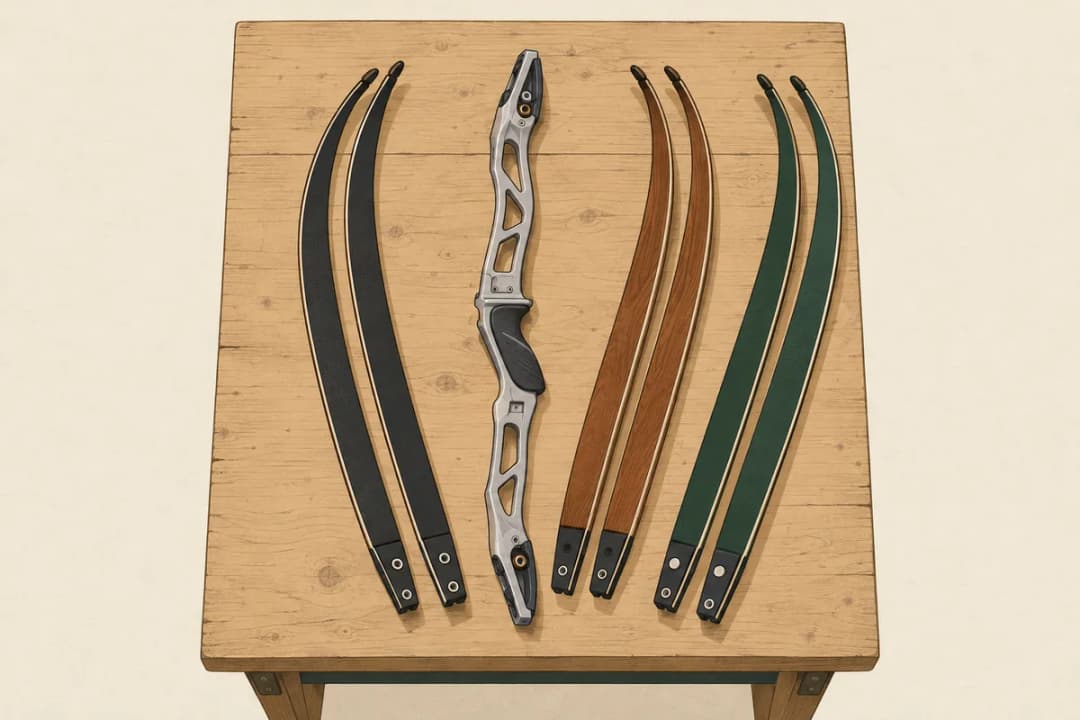


- If you think you’ll stick with archery, buy ILF: your riser stays, and you choose from hundreds of limbs as you move up.
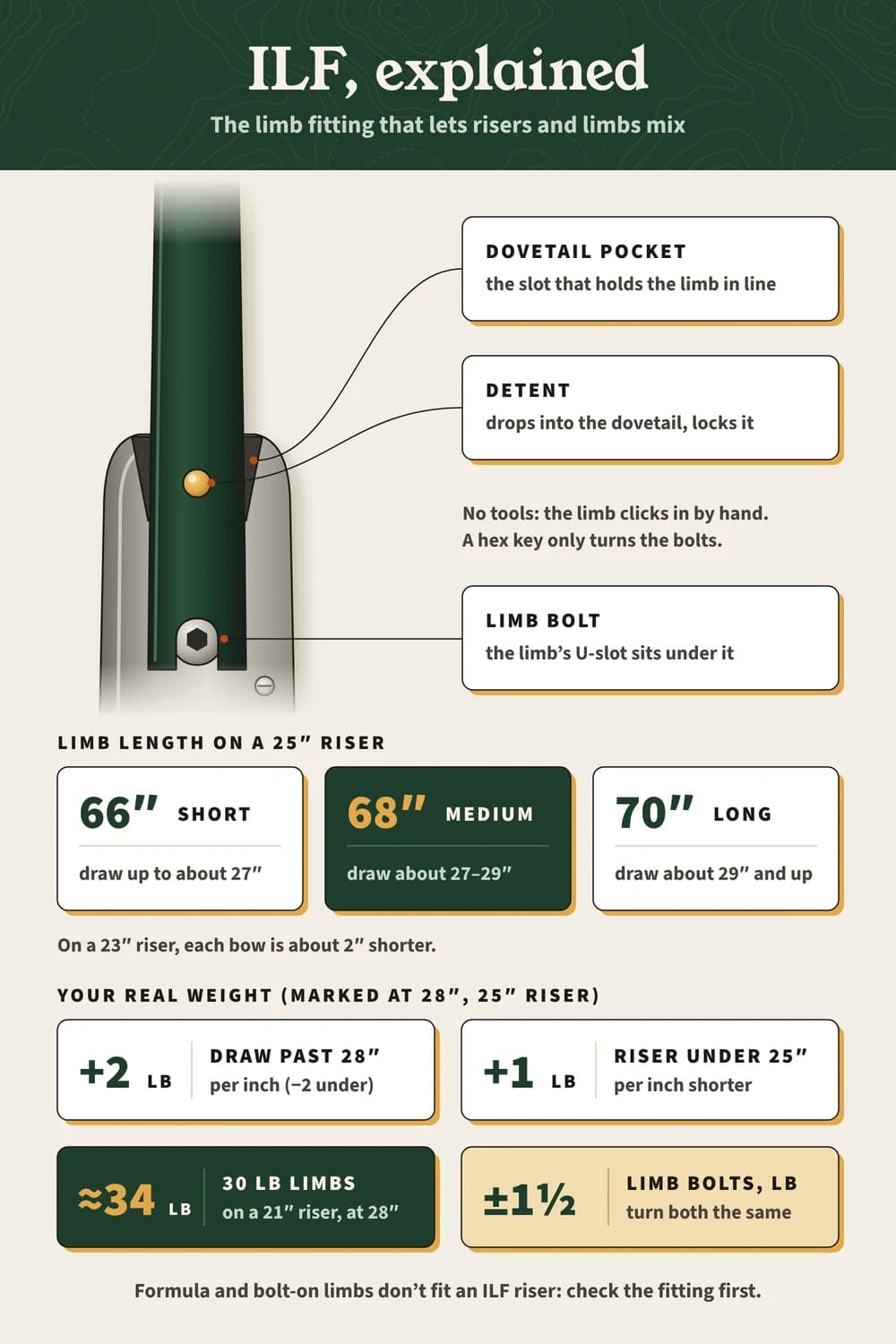
- On a 25″ riser, short, medium and long limbs make a 66″, 68″ or 70″ bow: pick by your draw length.
- Marked limb weight is at a 28″ draw on a 25″ riser; add about 2 lb per inch you draw past 28″, and 1 lb per inch of shorter riser.
- The limb bolts fine-tune draw weight by about 1½ lb either way; turn both the same so the tiller stays put.
- Most brands mix, not all perfectly, and Formula or bolt-on limbs don’t fit an ILF riser at all.
Will that riser fit those limbs from a different maker? If both say ILF (International Limb Fitting), almost always yes. 🙂
That’s why I’d buy ILF for any takedown bow you plan to keep. Below: how to pick limb length and weight, set the limb bolts and check the fit before your first arrow.
How an ILF fitting works: bolt, dovetail and detent
ILF started as Hoyt’s limb fitting and spread to other makers from the early 1990s. Today it’s the limb mount on nearly every target recurve, plus many barebow and hunting risers.
There are three parts, and you can see all of them on your bow. The limb slides in under the limb bolt and clicks into the dovetail pocket, and string tension holds it there.
- Limb bolt: the big bolt at each end of the riser. The U-shaped slot at the base of the limb sits under it.
- Dovetail pocket: the shaped slot on the riser that holds the limb in line.
- Detent: the button near the base of the limb that drops into the dovetail and locks the limb in place.
No tools are needed to fit or remove a limb: it clicks in by hand before you string the bow. You need a hex key only to turn the limb bolts.
// Free printable
Get the range log I actually use.
Seventeen printable pages: session log, score tracker, a 30-day drill challenge, a bow maintenance card, a first-season checklist and more. Join the monthly email and it lands right away.
How to choose ILF limbs: length first, then weight
ILF limbs come in short, medium and long, and the limb length plus the riser length sets your bow length. Get the length right for your draw first. Then pick the weight.
| Limbs on a 25″ riser | Bow length | Usually suits a draw of |
|---|---|---|
| Short | 66″ | Up to about 27″ |
| Medium | 68″ | About 27–29″ |
| Long | 70″ | About 29″ and up |
A 23″ riser makes each bow about 2″ shorter, so short limbs on it give you a 64″ bow. Measure your draw length before you choose, and treat the chart as a starting point a shop can confirm.
Weight is where most first limb sets go wrong. The number on the limb is its weight at a 28″ draw on a 25″ riser, so your real weight is different if your draw or your riser is:
- Your draw: add about 2 lb for every inch past 28″, and take off about 2 lb for every inch under it.
- Your riser: add about 1 lb for every inch your riser is shorter than 25″.
The riser rule comes from Hoyt’s recurve engineer, passed on in the Archery 360 video further down, it’s the one most people have never heard:
For a shorter riser you’re gonna add one pound of draw weight for every inch shorter than 25 inches.
That’s why a hunting riser feels so much heavier with the same limbs. 30 lb limbs on a 21″ riser pull about 34 lb at 28″, before your draw length adds anything, so buy the limbs for the riser they’ll go on.
Setting draw weight and tiller with the limb bolts
The limb bolts do more than hold the limbs. Turn both in and the draw weight goes up; turn both out and it goes down.
Hoyt measures its limbs with each bolt turned all the way in, then backed out three turns. Here’s how much room that leaves you, in the same video:
From there you can go three turns in and three turns all the way out, so six turns maximum out… plus or minus one and a half pounds from that middle setting.
Take that number seriously: the bolts fine-tune a few pounds, they don’t turn 30 lb limbs into 40 lb ones. Buy limbs within a pound or two of the weight you want, and use the bolts for the last bit.
- Loosen the locking screw beside each limb bolt, if your riser has one.
- Turn both bolts the same amount, a full turn at a time, and count the turns.
- Re-tighten the locking screws and check your tiller and brace height.
Turn one bolt more than the other and you change the tiller, the balance between the top and bottom limbs. Many ILF risers also have limb alignment screws that line both limbs up with the riser’s center; set those once, with a shop or the manual.
ILF vs Formula vs bolt-on limbs: which fit your riser
Three kinds of takedown fitting look alike on a shop wall. Only ILF limbs fit an ILF riser, so check the fitting before you check anything else.
| Fitting | Who uses it | Fits an ILF riser? | Limb choice |
|---|---|---|---|
| ILF | Most recurve makers | Yes | Hundreds of limbs, from budget to top-end |
| Formula | Mainly Hoyt (since 2009) | No: the fitting is longer | Fewer, mostly high-end |
| Bolt-on (maker-only) | Many budget takedowns | No | Only that maker’s limbs |
Formula isn’t better for a new archer, just more locked in. A bolt-on bow is fine to learn on if its maker sells limbs in the weights you’ll want next, but if you’re buying a riser to keep, make it ILF.
Mixing ILF brands: 4 checks before you shoot
Hoyt never published exact ILF measurments, so other makers measured it themselves. The answer to “will they fit?” from the same video is the honest one:
For the most part, absolutely… You might have a little bit of a tighter fit on some things, but they’ll usually work.
“Usually” is the word to notice. Most ILF limbs fit most ILF risers, but a loose pair shoots less consistently, so run these checks on any mixed setup:
- Snug fit: the limb shouldn’t rock in the pocket; a sloppy fit is noisy and less accurate.
- Slot on the bolt: the U-shaped slot at the base of the limb should sit squarely on the limb bolt, without play from side to side.
- Alignment: sight down the string; it should run down the middle of both limbs.
- Real weight: the marked weight can read higher or lower on another maker’s riser, so check it at your draw.
My first bow was a one-piece with no limb fitting at all, so when its weight turned out too heavy there was nothing to swap. Whatever you buy, buy it where someone can check the fit, which is the advice I give for any bow:
I don’t recommend necessarily getting a bow online, to be honest, even though I have an affiliate link for a bunch of this stuff. I actually think that you should go to a shop and get it fitted properly.
To pick ILF limbs without a calculator, keep this one-page summary of the fitting, the lengths and the weight rules handy.
// FAQ
Frequently asked questions
Quick answers to the questions readers ask most.
What does ILF mean on a bow?
International Limb Fitting: the limb mount most recurve makers use, so limbs and risers from different brands fit together.
Are all ILF limbs interchangeable?
Most are. Because ILF was never written down as a standard, a few combinations fit loosely or pull a different weight, so check the fit.
What length ILF limbs do I need?
On a 25″ riser, short limbs make a 66″ bow, medium 68″ and long 70″. Most adults with a 27–29″ draw start on mediums; the recurve buying guide has the full chart.
How much can I change draw weight with the limb bolts?
About a pound and a half either way on a Hoyt riser, a little more on some setups. Buy limbs close to the weight you want.
Can I put ILF limbs on a Formula riser?
No. Formula is a longer fitting, and ILF and Formula limbs and risers don’t mix.

Final thoughts
Buy ILF if you’re staying in the sport. Pick the limb length for your draw, the weight for your riser, and let the bolts do the last pound or two.
Note each limb set and its real weight in the free range log, so your next swap is a decision, not a guess.