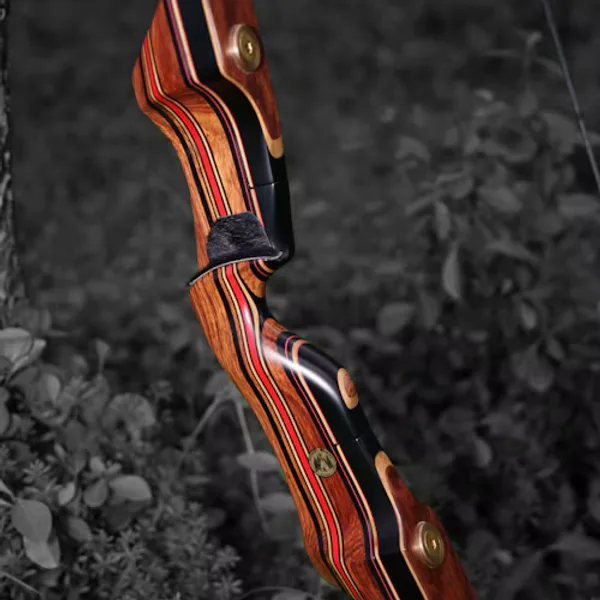
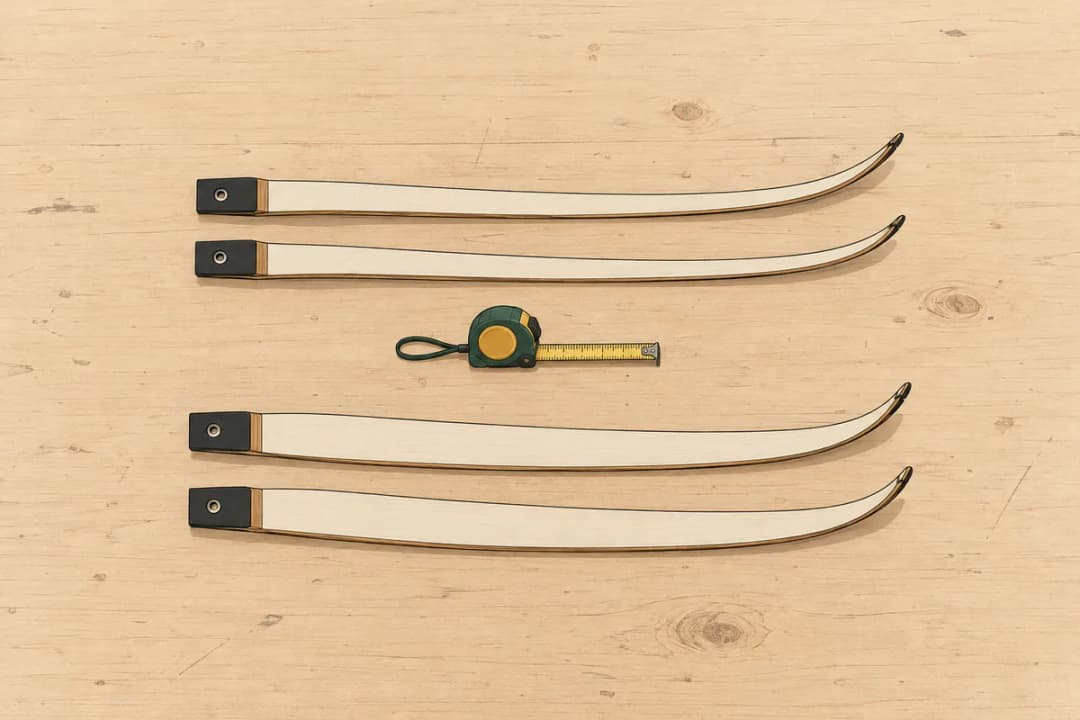


- Limbs are the flexible arms of the bow: they store the energy that drives the arrow and set your draw weight.
- Buy your first limbs lighter than you think. You’ll replace them, and that’s the point of a takedown.
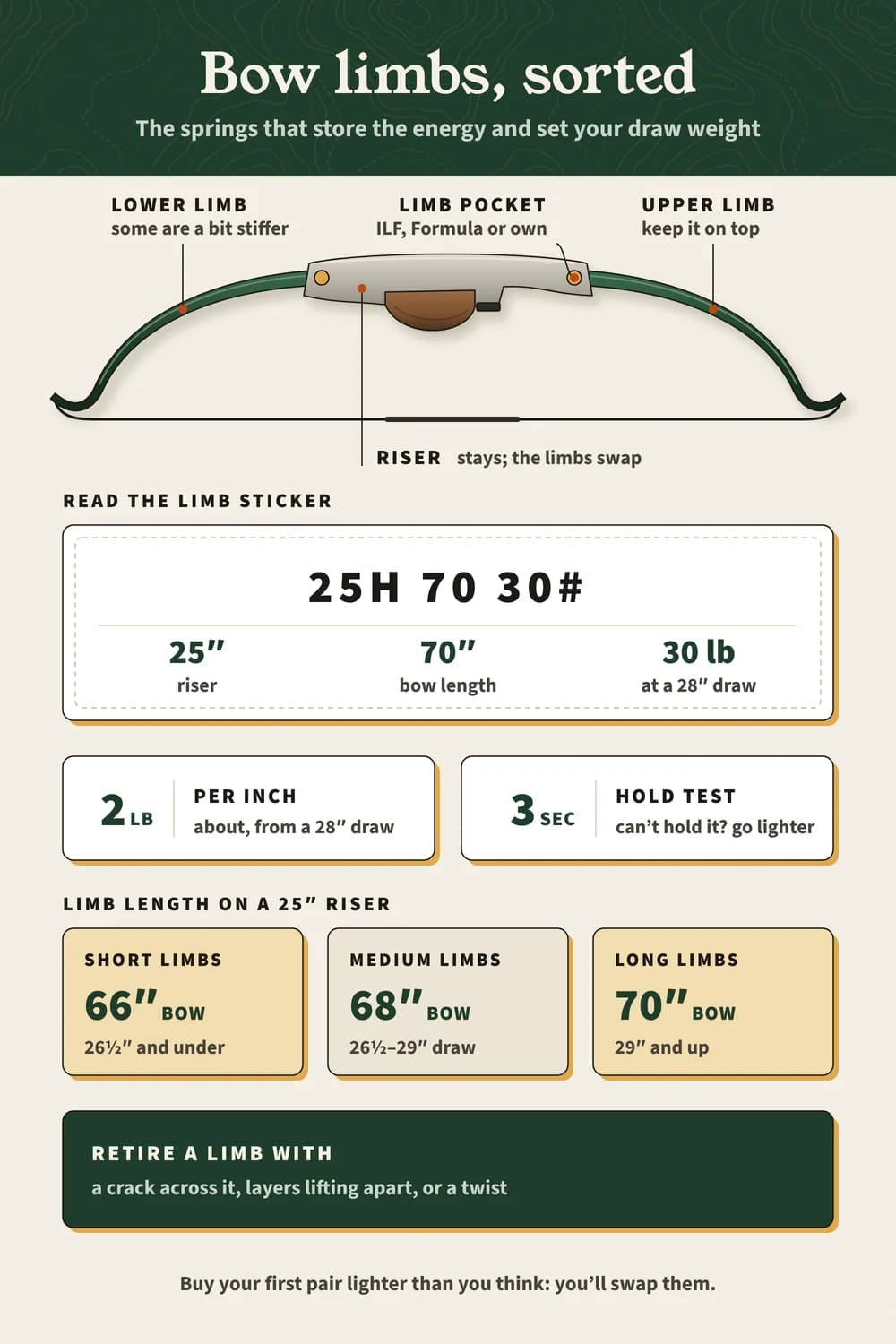
- The marked weight is measured at a 28″ draw; each inch longer or shorter adds or drops about 2 lb.
- Short, medium or long limbs plus your riser set the bow length, which you match to your draw length.
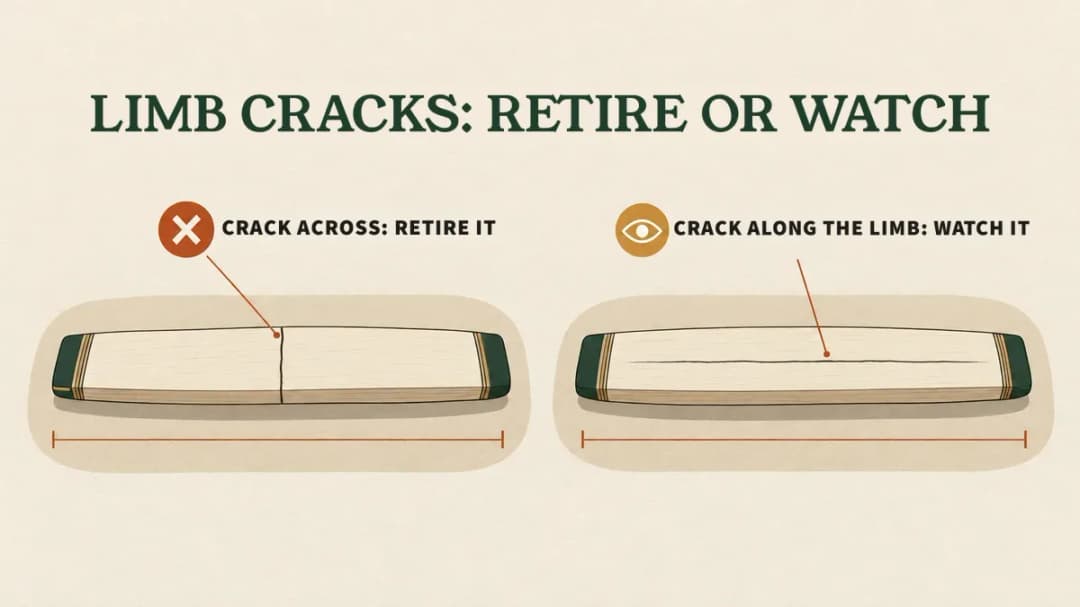
- Retire a limb with a crack across it, layers lifting apart, or a twist that pulls the string off-center.
The sticker said an easy number. Ten seconds at full draw and your arm is shaking too hard to aim. 💀
The fix costs less than you think: go lighter. On a takedown bow the limbs are the part you swap, so a lighter first pair is cheap and buys you clean form. Learn to read that sticker below and your next pair will be right the first time.
How bow limbs work: the springs that power your arrow
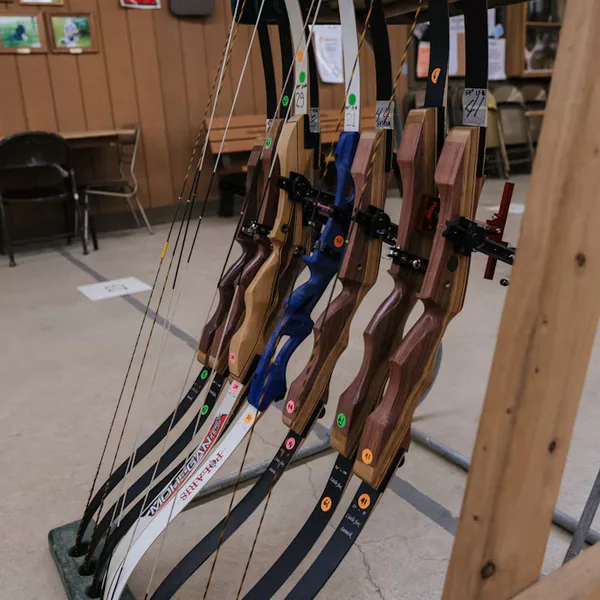
The limbs are the flexible upper and lower arms of the bow. When you draw, they bend and store energy; when you release, they spring forward and pass it through the string to the arrow.
On a takedown each limb is its own piece that fits a pocket on the riser, so you can change them. On a one-piece bow they’re part of the bow for good.
Compounds and crossbows have limbs too. Much stiffer and paired with cams. This guide is about recurve limbs, the ones you’ll actualy buy and swap.
// Free printable
Get the range log I actually use.
Seventeen printable pages: session log, score tracker, a 30-day drill challenge, a bow maintenance card, a first-season checklist and more. Join the monthly email and it lands right away.
Recurve limb weight: buy your first pair lighter than you think
The most common mistake new recurve archers make is starting with too much draw weight, says Hoyt’s recurve brand manager, and the limbs are where that choice lives. Too heavy, and you can’t reach your anchor, you shake at full draw, and you build habits you’ll have to unlearn.
I learned that one the hard way, on a 45 lb first bow:
The first time I tried to pull the 45 pounder, I could not do it, and I only got maybe three shots in before I was like, I’m done.
On a takedown, a lighter first pair is the cheap mistake to make. Many shops rent or exchange beginner limbs for exactly this reason; one UK shop swaps them free up to five times as archers build up.
- The hold test: pull to your anchor and hold for three seconds, long enough for a good breath. If you can’t, the limbs are too heavy.
- The end test: your last arrows of a session should look like your first; if your form falls apart halfway, go lighter.
- The budget rule: buy first limbs at the cheap end, since you’ll outgrow them long before you wear them out.
Reading a limb sticker: draw weight, riser and bow length
Most takedown limbs carry a small sticker with two rows of numbers. Each row gives the riser length, the finished bow length and the draw weight for that setup.
| Sticker row | Riser | Bow length | Draw weight at 28″ |
|---|---|---|---|
| 25H 70 30# | 25″ | 70″ | 30 lb |
| 23H 68 32# | 23″ | 68″ | 32 lb |
The weight is measured at a 28″ draw. Draw longer and the limbs pull heavier, about 2 lb per inch; draw shorter and they pull lighter, so a 30 lb limb is roughly 26 lb at a 26″ draw.
Keep the upper limb on top. Limbs are marked upper and lower, and some makers build the lower limb slightly stiffer.
Choose your limb length: short, medium or long by draw length
Limbs come short, medium or long, and together with the riser they set the bow’s length. Match the bow length to your draw length: a longer draw needs a longer bow.
| Your draw length | Limbs on a 25″ riser | Bow length |
|---|---|---|
| 26½″ and under | Short | 66″ |
| 26½–29″ | Medium | 68″ |
| 29″ and up | Long | 70″ |
That’s Archery 360’s chart and two-time Olympic silver medalist Jake Kaminski gives almost the same numbers in his video on limb length:
If you’re in that 28 inch draw length range, a medium set of limbs and a 25 inch riser, so a 68 inch bow would be pretty good. You know, anything over 29 inches and above, you’re looking at at least a 70 inch bow.
Two charts agreeing is a good sign, so measure your draw before you buy limbs (the draw length calculator gets you close), and buy the length the chart gives you.
Kaminski also explains why a bow that’s too short for you shows up as pinched fingers:
People who have a very long draw length will want to have a longer bow in general because the string angle as you pull back more and more and more gets more and more severe and it starts to pinch your fingers.
So if you fall between two lengths, pick the longer limbs. A slightly long bow costs you a little speed; a short one pinches your fingers on every shot, and he adds that small changes in finger pressure move the arrow more on a short bow:
In general a shorter bow, when you make slight changes in your finger pressure on the string, that can affect the trajectory of the arrow pretty dramatically on a shorter bow than a longer bow, mostly in my opinion is because of the string angle.
That’s exactly the kind of mistake beginners make all session. A forgiving bow is worth more to you now than a fast one.
How to swap your limbs in 6 steps
Moving up in weight on a takedown takes ten minutes. Do it with the bow unstrung, with a stringer, every time.
- Check the fit first: the new limbs must use your riser’s fitting (ILF, Formula or the maker’s own) and suit its length.
- Unstring the bow with a bow stringer.
- Take the old limbs off: slide ILF limbs out of their pockets, or unscrew the limb bolts on a bolt-on takedown.
- Fit the new limbs, upper limb on top (it’s marked near the fitting), and make sure each one seats fully in its pocket.
- String the bow with the stringer and check the string runs down the middle of both limbs.
- Check brace height and tiller before you shoot, and recheck your arrow spine for the new weight.
Limb materials: fiberglass, wood core, or foam and carbon
Limb material changes how the draw feels, not whether you can learn on it. For a first pair, fiberglass or wood-core limbs are all you need, because you’ll outgrow the weight before you outgrow the quality.
- Fiberglass: the budget choice, made for archers who are moving up in weight; it tends to stack (get heavier fast) near full draw.
- Wood core: usually maple or bamboo inside, the most popular core, with a damped, quiet feel on release.
- Foam and carbon: mostly high-end; smooth through the draw, snappy on release and steadier in changing weather.
When to retire a limb: cracks, twist and storage
Look over your limbs whenever you string the bow. A crack that runs across a limb, or layers lifting apart, means you stop shooting it today.
- Cracks: retire a limb with a crack across it; small lengthwise cracks in the glass are less serious but need watching.
- Twist: sight down the string; it should run down the middle of both limbs.
- Heat: don’t leave limbs in a hot car for long; heat weakens the glue between the layers and can twist or delaminate them.
- Storage: never stand the bow on one limb, and unstring it between sessions.
The fastest way to crack a limb is a dry fire. An arrow on the string, every shot.
Here's everything about limbs from this guide on one page, handy to have open when you're reading stickers at the shop.
// FAQ
Frequently asked questions
Quick answers to the questions readers ask most.
What are limbs on a bow?
The flexible upper and lower arms that bend when you draw and store the energy that shoots the arrow.
Can I put heavier limbs on my bow?
On a takedown, yes, as long as they use the same fitting as your riser and stay under the riser’s maximum draw weight.
Do ILF limbs fit any riser?
They fit most ILF risers from any maker. They don’t fit Formula or maker-only risers.
Are the upper and lower limbs different?
They’re marked, and some makers make the lower one slightly stiffer. Keep each limb in its own pocket.
Do expensive limbs make you shoot better?
Not when you’re starting. The smoother draw of top limbs takes years to feel, so put the money into lighter limbs and lessons first.

Final thoughts
Light first, swap later. That’s the whole reason to own a takedown, so use it.
Log each pair’s weight and how your groups look in the free range log, and you’ll know exactly when you’re ready for the next one.