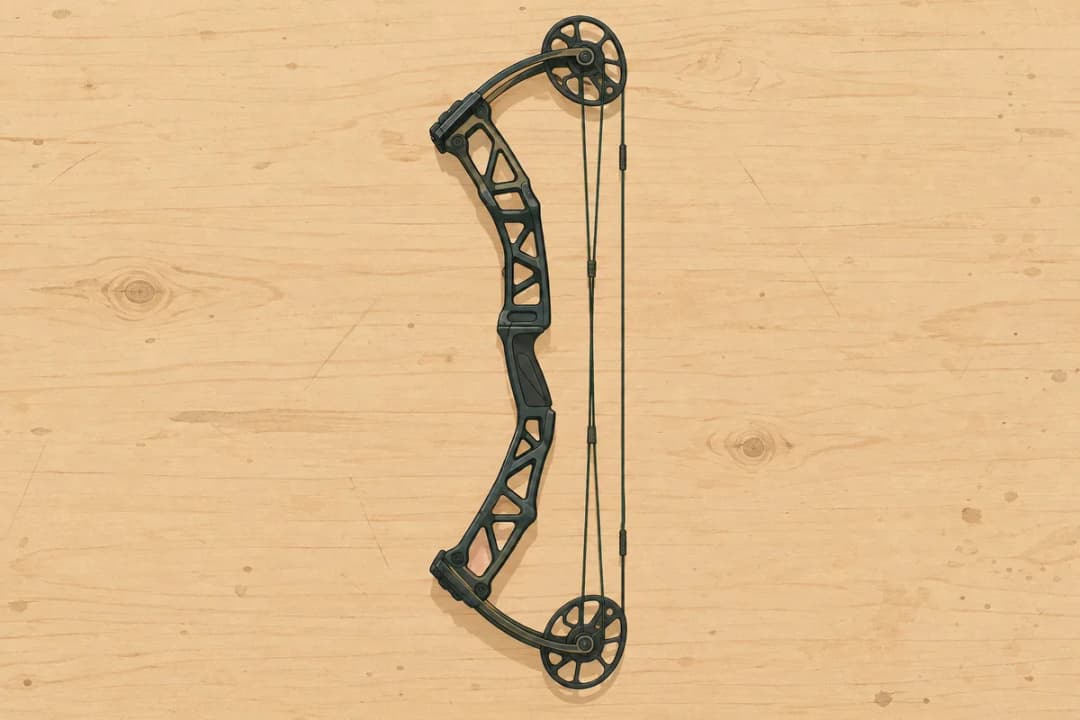


- A compound’s cams and cables drop the weight you hold at full draw, commonly by 65–80%.
- For a first compound, buy one with a wide draw length and draw weight range so it can be set to you and grow with you.
- A 7″-ish brace height and a mid-length axle-to-axle are the forgiving choices; short and fast is harder to shoot well.
- It must be set to your exact draw length at a pro shop, and most work on it needs a bow press.
- Learn form on a recurve first, then buy the compound.
A compound bow is the most precise bow you can hold, and that’s exactly why it’s a poor teacher. 😮 Its cams cut the weight at full draw, so it hides the form errors you most need to see.
So learn your form on a recurve first (start with how to choose a recurve), then buy a compound set to your draw length with the specs below.
How a compound bow works: 4 parts that do the job
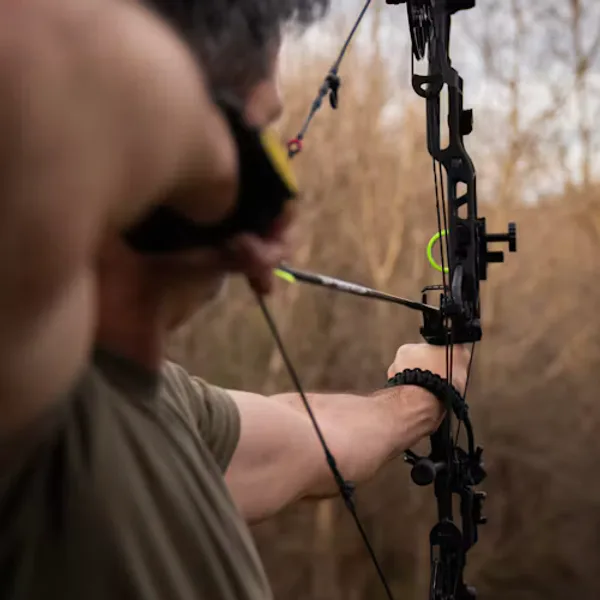
A compound bow has cams, oval wheels on the limb tips, tied to the opposite limbs by cables. As you draw the cams turn like a pulley system: the weight climbs to a peak, then drops away sharply near full draw.
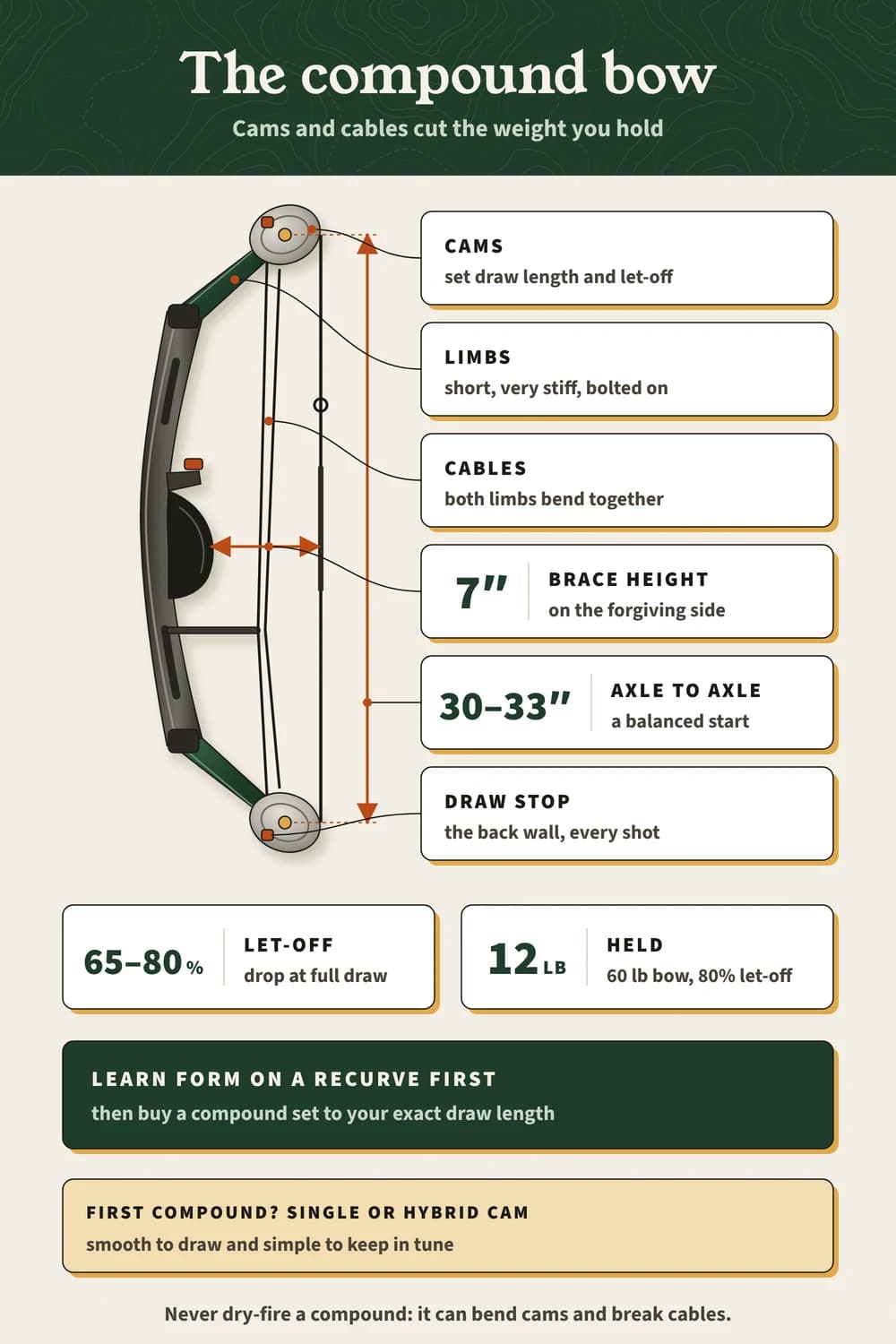
That drop is called let-off. On a 60 lb bow with 80% let-off, you hold just 12 lb at full draw, which lets you aim calmly for several seconds.
- Cams: the wheels at the limb tips; their shape sets the draw length, the let-off and how the draw feels.
- Cables: link each cam to the opposite limb, so both limbs bend together.
- Limbs: short and very stiff, bolted into a machined metal riser.
- Draw stops: a hard stop at full draw, the back wall, so you pull to the same length every shot.
The staff at Dead-On Archery, a pro shop, put real numbers on let-off while comparing a hunting setup with a target setup:
Your hunting bow is typically going to be like 80 to 85 percent let off, so that means is when you get to full draw you’re only holding 15 to 20 percent of the max weight of the bow.
Notice the other half of that comparison: the target bow beside it ran around 65–70% let-off. More let-off makes holding easier, not the shot better. So I’d start a first compound in the middle.
 From Jedain
// Free printable
Get the range log I actually use.
Seventeen printable pages: session log, score tracker, a 30-day drill challenge, a bow maintenance card, a first-season checklist and more. Join the monthly email and it lands right away.
Compound cam systems: single, hybrid, binary or dual
The cams are the engine, and they come in four common layout’s. For a first compound, a single cam or a hybrid is the easy choice: smooth to draw and simple to keep in tune.
| Cam system | How it’s built | What it means for you |
|---|---|---|
| Single cam | One cam on the bottom limb, an idler wheel on top | Simple and often called the easiest to tune; usually a little slower |
| Hybrid cam | Two different cams working together | A smooth draw with speed close to dual cams |
| Binary cam | Two cams slaved to each other | Both turn the same amount, so timing stays put after the first tune |
| Dual cam | Two matching cams, one per limb | Fast and adjustable, but more demanding to keep in time |
The cam system matters less than fit. A well-fitted single-cam bow beats a fast dual-cam bow set to the wrong draw length every time.
Compound vs recurve: what changes for you
The shot feels different from start to finish. A recurve gets heavier all the way to your anchor; a compound peaks partway through the draw and then lets you settle against the back wall.
| What changes | Compound | Recurve |
|---|---|---|
| Weight at full draw | A fraction of the peak (let-off) | The full draw weight, still climbing |
| Draw length | Fixed by the cams; must fit you | As far as your anchor |
| Letting go | A release aid, almost always | Fingers, with a tab or glove |
| Aiming | A sight on the bow and a peep in the string | Often no sight at all |
| Speed | The fastest hand-held bow | Well short of a compound |
| Changes and repairs | A bow press, usually at a pro shop | Swap limbs at home on a takedown |
The compound’s precision is real, but much of it comes from the machine. The cams carry the weight, the sight and peep line up your eye, and the release aid lets the string go cleanly.
Why I’d learn form on a recurve before buying a compound
I came to archery from firearms, so I see the compound’s appeal:
It would be a real good bridge between my experience with firearms.
To be clear, I haven’t shot a compound yet, so this stance is an opinion from research, not range time. But I learned on a recurve, and the mistakes I made for too long (not pulling to my cheekbone, a sloppy stance) are exactly the kind a recurve makes you fix.
- Your anchor and release are yours: no peep or trigger covers for them, so you build them properly.
- Getting stronger is cheap: a takedown recurve takes heavier limbs; changing a compound means a shop visit.
- The skills carry over: stance, back tension and follow-through work the same on a compound.
The exception: if you’re buying a bow to hunt this season and there’s no time for a detour, go straight to a compound. Get it fitted at a pro shop and take a lesson or two.
How to choose your first compound: 5 specs to get right
When you do buy one, buy it at a pro shop, set to your draw length. Set too long, a compound makes a consistent anchor nearly impossible; too short, and you bend your bow arm or shift your anchor to make up for it.
- Draw length: measured on you and set exactly on the cams; a bow with a wide adjustable range can follow you if your form changes (the draw length guide gets you close at home).
- Peak weight: lighter than you think, on a bow whose weight range lets you turn it up later; you still pull the full peak every shot.
- Let-off: a mid-range let-off keeps you honest about your form; very high let-off makes holding easy but can feel mushy at full draw.
- Brace height: around 7″ is on the forgiving side; short brace heights add speed and punish form errors.
- Axle-to-axle length: longer bows hold steadier, shorter ones are handier in a blind or treestand; around 30–33″ is a balanced start.
If you can’t decide between a target bow and a hunting bow, the same shop has a simple rule:
If you want to do both probably lean towards getting that bow hunting bow because hunting with the target bow is a lot harder than shooting target with a hunting bow… you might go with that 33 you know kind of that happy medium, a little bit of a target bow, a little bit of a hunting bow.
That matches the specs above. A hunting-style compound around 33″ axle to axle is the one bow that does both jobs well enough while you find out which one you love.
Here are the parts and the five numbers that matter, all on one page you can take to the pro shop.
// FAQ
Frequently asked questions
Quick answers to the questions readers ask most.
Is a compound bow good for beginners?
Many people start on one, and the let-off makes holding at full draw easy. I’d still learn form on a recurve first, because a compound’s sight and release can cover for mistakes.
What let-off should my first compound have?
A mid-range let-off is a good start. It still makes holding easy, and a firmer back wall gives you feedback on every shot.
Can you shoot a compound bow with your fingers?
You can, but almost everyone uses a release aid. Modern compounds are short, so the string pinches your fingers at full draw.
Can I change a compound bow’s draw length at home?
On some cams, yes, with a module or a setting change from the manual. Strings, cables and many cam changes need a bow press, so a pro shop is the safe choice.
How fast is a compound bow?
Speed ratings are measured on a 70 lb, 30-inch setup with a light arrow. Your real speed runs lower with a shorter draw or a heavier arrow.
Final thoughts
A compound is a precision machine, and it’s worth owning. Bring good form to it, built on a recurve, and buy one fitted to your draw length with room to grow.
Track your groups in the free range log so you know your form is ready when you make the switch.