

- Check the center serving and both end servings every time you wax or string the bow.
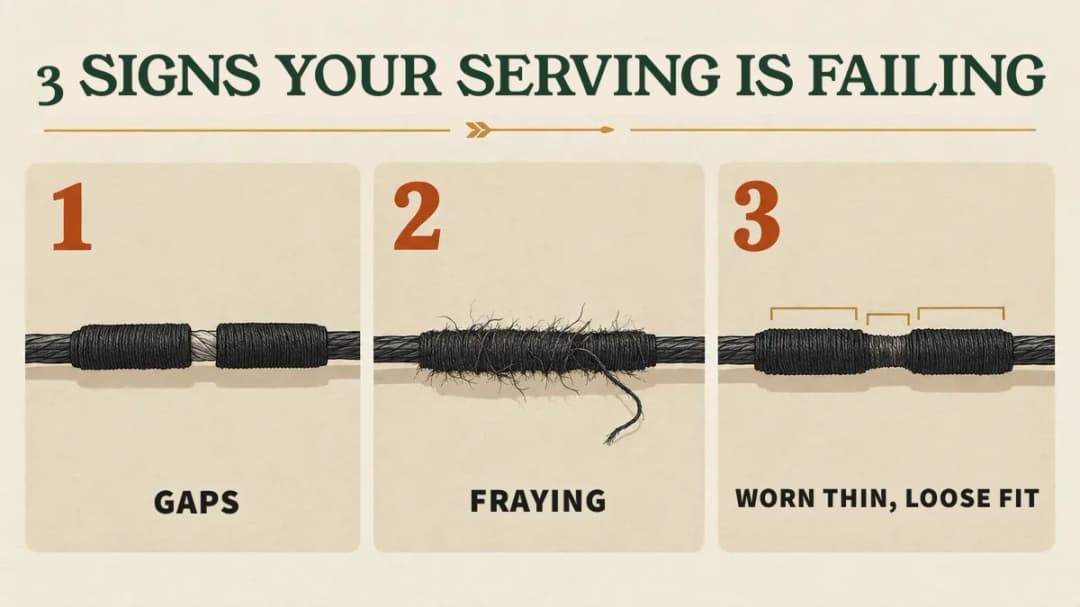
- Gaps, fraying or a looser nock fit are the 3 signs a serving is failing.
- Fix it before your next session: press a small gap closed, and re-serve anything loose or worn.
- A good re-serve locks the lead line in as it goes, so the new serving can’t creep.
- Broken strands under the serving mean a new string, not a re-serve.
That small gap in the wrapped thread in the middle of your bowstring? It can’t wait. 😬
Fix it before your next session: a loose serving changes how your arrow sits on the string and lets the strands underneath wear. Keep wax off it too, as the bowstring waxing guide explains. Here’s how to check it, which fix you need and how a re-serve is done. 🧵
How serving protects your string: center and end servings
A bowstring is a bundle of thin strands, and bare strands wear fast wherever something rubs them. Serving is thread wound tightly over those spots so the thread takes the wear instead of the string.
Center serving: the long wrap in the middle, where the arrow nocks and your fingers, tab or release sit. It takes the wear of nocking and shooting, and its thickness decides how snugly the nock snaps on.
End servings: the wraps on each loop, where the string sits in the limb tips of a recurve or longbow, or runs around the cams of a compound.
| Serving | Where it is | Its job | What wears it |
|---|---|---|---|
| Center | Middle of the string | Protects the string and sets the nock fit | Nocking, your fingers or release, the rail on a crossbow |
| End (one per loop) | Each end loop | Protects the string at the limb tips or cams | The limb tips, and the load on a compound’s cams |
Your nocking point sits on the center serving too. A serving that slips can take the nocking point with it, and then every arrow sits in a slightly different spot.
 From Jedain
// Free printable
Get the range log I actually use.
Seventeen printable pages: session log, score tracker, a 30-day drill challenge, a bow maintenance card, a first-season checklist and more. Join the monthly email and it lands right away.
How to check your serving: 3 signs it’s failing
Check the serving every time you wax or string the bow. Any one of these three means it’s time to fix it.
- Gaps or separation: the wraps have opened, so you can see the string’s strands between them.
- Fraying or fuzz: loose fibers, a flattened patch where your fingers sit, or an end that has started to unwind.
- A nock that fits differently: arrows slide down the string or fall off too easily, because the worn serving is thinner than it was.
A good nock fit is easy to test. The nock should snap on with a soft click and hold the arrow hanging from the string, but come off with a light tap.
Which fix you need: close the gap, re-serve or replace
Fix it now, not when it gets worse. A small gap is a few minutes’ work; a serving that unravels mid-session leaves the string bare right where your fingers hit it.
My bow stays strung most of the time, so it’s string is under load almost every day, and I don’t let a gap on it sit for even one session. The right fix depends on how bad the damage is:
| What you see | The fix | Who does it |
|---|---|---|
| A small gap, wraps still tight | Press the wraps back together with a fingernail | You, in a minute |
| Loose, worn or unwinding serving | Re-serve that section | A bow shop, or you with a serving jig |
| Broken strands, or an old, stretched string | Replace the string | A shop, or you with a bow stringer (compounds need a bow press) |
Re-serving a worn-out string just hides the problem, so if the strands themselves are tired, spend the money on a new string.
How a center serving is re-served, step by step
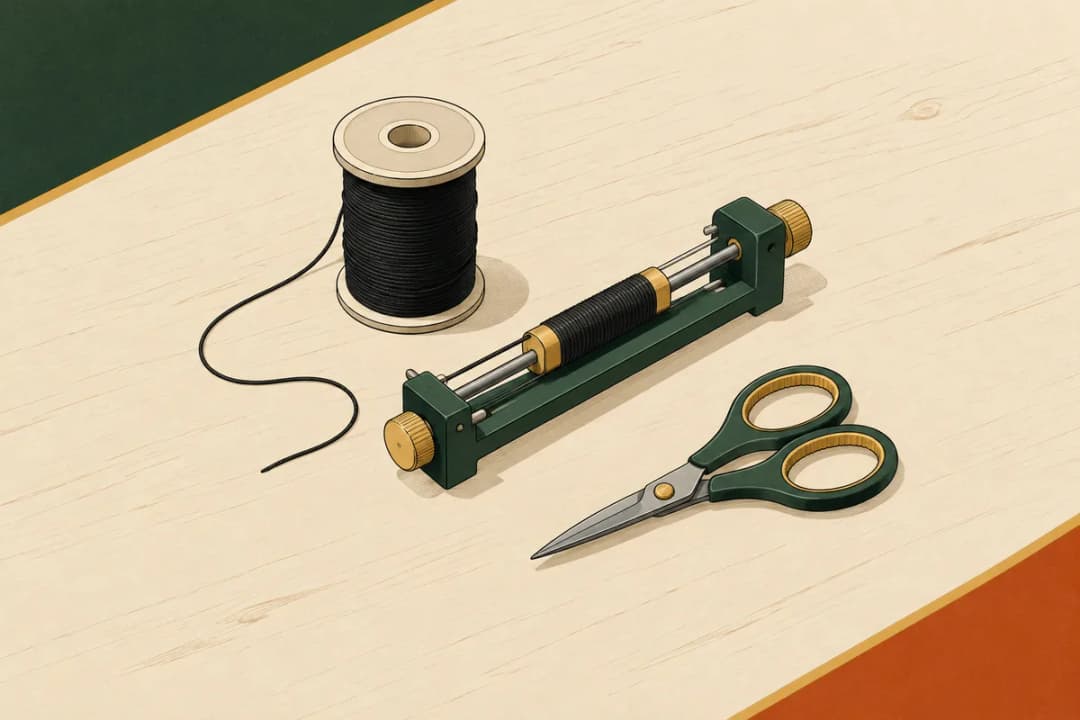
For your first one let a shop do it and watch. If you want to do it yourself, you need serving thread in the right size for your nocks, a serving jig, a sharp blade and a lighter.
- Measure the nocking point with a bow square before you remove anything, so you can put it back.
- Unwind the old serving and the nocking points, without cutting the string strands.
- Start the new serving: lay a tag end along the string and wrap over it, keeping steady tension with the jig.
- Lock the lead line in as you go, so the serving can’t creep along the string.
- Tie it off by serving back over a loop and pulling the end under the last wraps, then trim the ends.
- Re-tie the nocking point at the height you measured, and check the nock fit.
Step 4 is the one most guides leave out. Champion compound archer Levi Morgan does it on every serving he makes, and explains how in the video below:
If I’m doing like a center serving or shorter, I’ll weave that lead line in every 10 wraps… The serving can’t crawl because it’s connected to that lead line the whole time.
That’s the fix for the exact problem in this post. A serving that crawls is a serving that opens up, and tying the lead line in all the way along stops it at the source.
For longer sections he spaces the weave out, but never by much:
If I’m doing a big section of string I’ll go every 25 wraps. I don’t ever go any further space than that without weaving that lead line in.
Ten wraps on a center serving, 25 on a long section: write those two numbers on your serving jig and you won’t forget them.
Serving on a crossbow string: the rail takes its toll
Crossbow strings are served too, and the center serving slides along the rail on every shot, which wears it faster than a vertical bow’s. Keep the rail lubed the way your manual says. Because a dry rail wears the serving fast.
Take an unwrapping crossbow serving to a shop before you shoot again. A serving that separates can expose the string, and a string that breaks on firing can damage the crossbow. The crossbow strings guide covers replacing one.
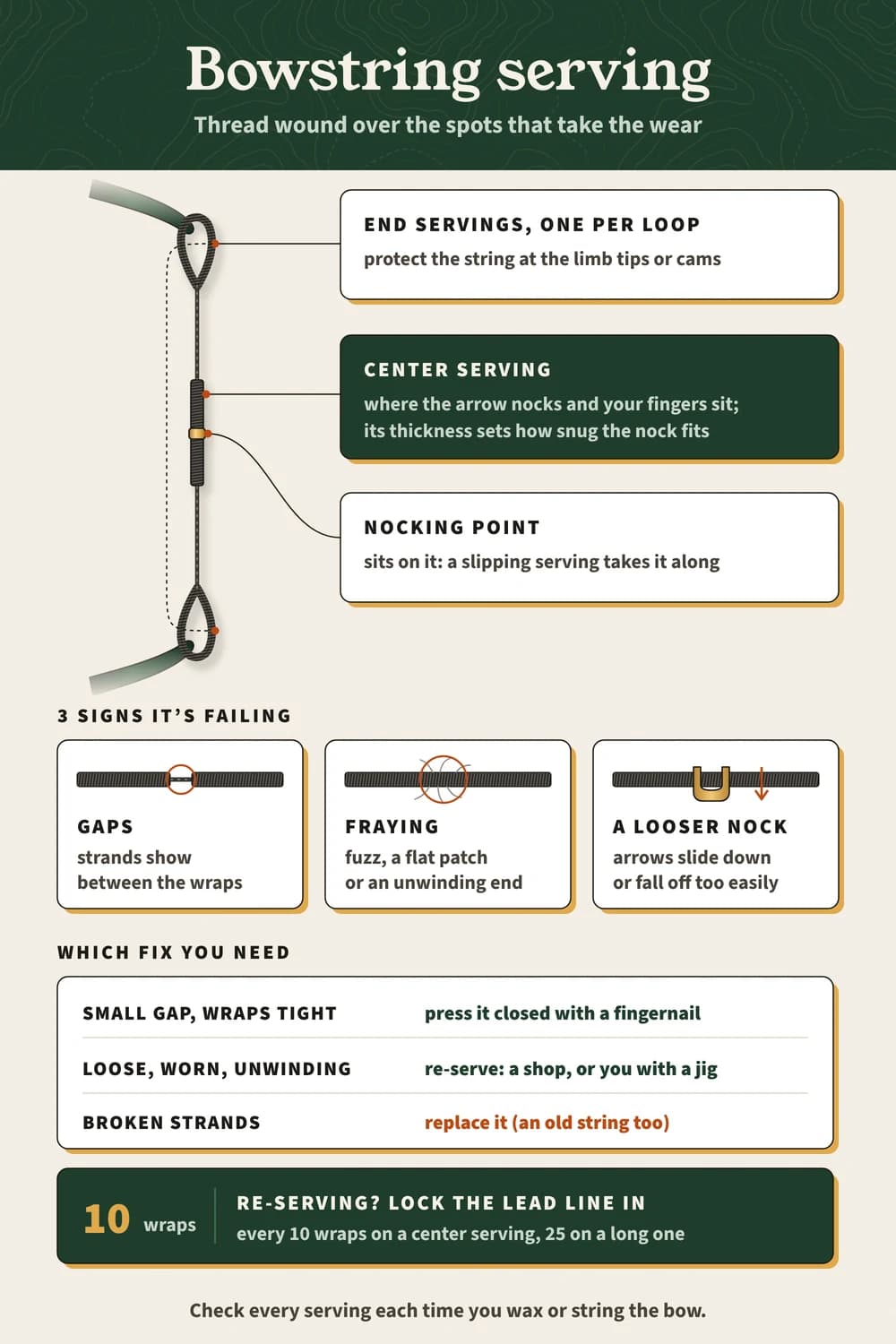
Here's the quick check on one page: where the servings are, what failing looks like and the fix for each.
// FAQ
Frequently asked questions
Quick answers to the questions readers ask most.
Can you shoot with a separated serving?
Not for long. Fix it before your next session: press a small gap closed, and have a loose serving re-served.
How do I know if my nock fits the serving?
It should snap on with a soft click and hold the arrow hanging from the string, but come off with a light tap.
Should you wax the serving?
Not on a recurve, longbow or compound: wax only the bare strands. On a crossbow, follow the manual.
Can I re-serve a bowstring myself?
Yes, with a serving jig, the right serving thread, a blade and a lighter. Measure your nocking point first so you can put it back.
Should I re-serve or replace the string?
Re-serve when the string itself is sound. Replace it when strands are broken or the string is old and stretched.
Final thoughts
Serving is the cheapest part of your bow to fix and one of the easiest to ignore. Look at it every session and fix it the day it opens.
Note string checks and re-serves in the free range log, so you know how old your string really is.
Serving protects the middle of the string; wax protects the rest. How to wax a bowstring takes 5 steps and keeps the wax off the serving you just fixed.